
The specialised programme in Jaipur strengthened digital-design capabilities, industry knowledge and professional cooperation between Sri Lanka and India.
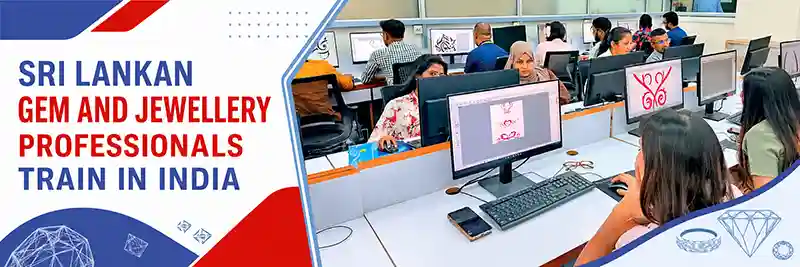
A 29-member delegation from Sri Lanka’s gem and jewellery sector has completed an intensive 18-day capacity-building programme in India, gaining practical exposure to modern jewellery-design tools, production processes and 3D-print-ready development.
Published: 17 August 2026
Twenty-nine Sri Lankan gem and jewellery professionals participated in a specialised training and capacity-building programme held in Jaipur, Rajasthan, from 6 to 23 July 2026.
The programme was conducted by the Government of India through the Indian Institute of Gems and Jewellery in Jaipur, commonly known as IIGJ Jaipur.
According to a Daily FT report, the curriculum combined technical instruction, practical design exercises and industry exposure intended to strengthen professional competencies across the gem and jewellery value chain.
The programme focused particularly on practical digital-design tools, editing techniques and the preparation of 3D-print-ready outputs—capabilities that increasingly connect creative jewellery concepts with modern prototyping and manufacturing.
From Creative Concepts to Production-Ready Designs
Jewellery production is becoming increasingly connected to computer-aided design, three-dimensional modelling and digital manufacturing systems.
Traditional drawing and handcrafting skills remain central to the industry. However, digital-design tools allow jewellery designers to refine measurements, assess proportions, adjust gemstone placement and visualise complex pieces before physical production begins.
Creating a production-ready digital model can help designers communicate more effectively with manufacturers and reduce the number of physical prototypes required during product development.
The Sri Lankan participants were introduced to practical tools and editing processes used to move designs towards 3D-print-ready output.
While the programme provided a foundation for developing advanced capabilities, the available report does not specify individual participant qualifications, completed projects or commercial outcomes. Claims about new businesses, employment, export contracts or revenue should therefore not be made without further evidence.
SRI LANKA–INDIA SKILLS COOPERATION
Sri Lankan professionals
Specialised training
Programme period
Training institution
Training at IIGJ Jaipur
The Indian Institute of Gems and Jewellery operates specialist education and professional-development programmes covering jewellery design, computer-aided design, manufacturing, gemmology and merchandising.
Its jewellery-design and CAD courses combine theoretical instruction with practical experience in digital modelling and production preparation.
The institute explains that modern CAD education can help participants develop precise three-dimensional models, translate two-dimensional concepts into digital designs and prepare files for prototyping and manufacturing.
These capabilities are increasingly important for businesses producing customised jewellery or working with manufacturers, casting specialists, gemstone setters and international buyers.
The training delivered to the Sri Lankan delegation was shorter than IIGJ’s regular diploma programmes. It should therefore be understood as a targeted capacity-building initiative rather than a full professional diploma or degree.
Exposure to India’s Jewellery-Manufacturing Ecosystem
Classroom and practical instruction were complemented by industry exposure.
Participants visited Valentine Silver International in Jaipur, where they received first-hand exposure to contemporary production technologies, design-development processes and modern retail practices.
Industry visits can provide an important bridge between technical instruction and commercial application. Participants can observe how designs move through production, quality-control, finishing, presentation and retail stages.
Jaipur is internationally recognised for gemstone processing, jewellery manufacturing and traditional craftsmanship. The city combines long-established artisan knowledge with large-scale production and contemporary design practices.
This environment provided the Sri Lankan delegation with an opportunity to examine how heritage craftsmanship and modern production technologies can operate within the same commercial ecosystem.
Part of a Wider Bilateral Commitment
The July 2026 programme was organised under an expanded India–Sri Lanka capacity-building framework announced by Indian Prime Minister Narendra Modi during his visit to Sri Lanka in April 2025.
Under the initiative, India committed to providing 700 customised training places annually for Sri Lankan professionals across selected industries and public-sector fields.
An earlier programme held in December 2025 brought 20 Sri Lankan professionals from the gemstone cutting and polishing segments to IIGJ Jaipur for specialised technical training.
According to the High Commission of India in Colombo, that programme covered cleaving, sawing, pre-forming, shaping, cutting, faceting, polishing and quality assessment.
The July 2026 programme broadened this cooperation by giving another group of professionals exposure to digital jewellery development and production-ready design processes.
The National Gem and Jewellery Authority had earlier publicised the opportunity in collaboration with the High Commission of India and Sri Lanka’s Ministry of Industry and Entrepreneurship Development.
Creative idea and visual direction
Building the three-dimensional form
Refining proportions and details
Preparing the model for prototyping
Why Digital Capability Matters for Sri Lanka
Sri Lanka possesses a globally recognised gemstone heritage and a substantial base of skilled cutters, jewellers, designers and traders.
However, international competitiveness increasingly depends on more than access to valuable gemstones. Design quality, consistency, production efficiency, certification, branding and the ability to respond to customised orders all influence the final value of a jewellery product.
Digital-design capability can help Sri Lankan businesses move beyond selling stones as raw or semi-processed materials by supporting the development of higher-value finished jewellery.
It can also assist smaller businesses in presenting designs professionally to clients and production partners before committing to expensive materials.
These benefits are not automatic. Participants require access to appropriate software, computers, prototyping facilities and continued technical mentoring after completing short-term training.
The programme’s longer-term value will therefore depend on how effectively the acquired knowledge is shared and applied within Sri Lanka’s businesses, workshops and training institutions.
Strengthening Professional and Institutional Connections
Capacity-building programmes can create value beyond the technical curriculum.
They allow participants to form professional connections with instructors, manufacturers, designers and other sector specialists. These relationships may support future knowledge exchange and institutional cooperation.
The programme also demonstrates a practical dimension of Sri Lanka–India relations. Rather than limiting bilateral engagement to official meetings and policy announcements, customised training places professionals inside working educational and industrial environments.
The Daily FT reported that the initiative contributed to strengthening competencies and deepening institutional and industry connections between the two countries.
Nevertheless, no business agreements, investment commitments or export contracts were announced as part of the programme. The achievement should be reported as a skills-development and knowledge-exchange initiative.
Building More Value Around Sri Lankan Gems
Sri Lanka is widely associated with sapphires and other coloured gemstones, but the greatest commercial returns are often created through the stages that follow extraction.
Cutting, polishing, treatment disclosure, certification, design, manufacturing, branding and international retail all influence the value eventually captured from a gemstone.
Developing stronger jewellery-design and production capabilities can support Sri Lanka’s effort to retain more value within the country.
This requires a coordinated approach involving artisans, exporters, educational institutions, technology providers, regulators and industry associations.
International training can provide useful knowledge and exposure, while Sri Lankan institutions must create the environment necessary for participants to apply what they have learned.
The SLD Perspective
The participation of 29 Sri Lankan gem and jewellery professionals in the Jaipur programme represents a constructive investment in industry knowledge.
Sri Lanka’s gemstone reputation is already well established. The next competitive advantage must come from combining that natural heritage with sophisticated design, modern technology, consistent production and compelling international presentation.
The most important measure of the programme will not be the number of days spent in training. It will be how effectively the participants translate their learning into stronger designs, more efficient production and knowledge shared across the local industry.
Continued Sri Lanka–India cooperation can provide valuable technical exposure, but sustainable progress requires follow-up support, access to technology and opportunities for trained professionals to apply their skills.
When traditional craftsmanship is strengthened by modern digital capabilities, Sri Lanka is better positioned to create finished products that carry both greater commercial value and a distinctive national identity.
