
Blue-whale observations off southern Sri Lanka inspired questions that would shape her future research.
How a pioneering Sri Lankan marine biologist transformed blue-whale research and locally led ocean conservation
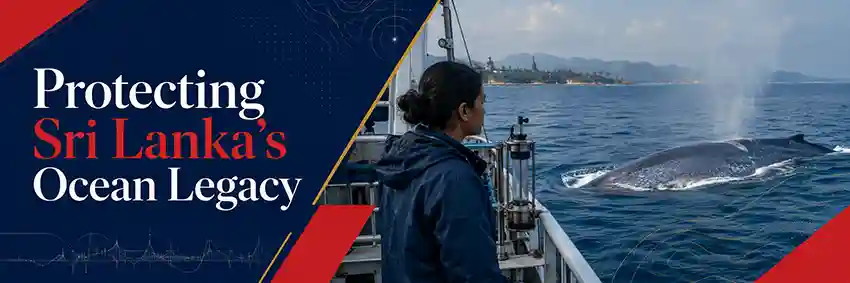
From pioneering research on Sri Lanka’s “unorthodox” blue whales to building opportunities for locally led marine science, Dr. Asha de Vos has transformed how Sri Lanka’s oceans are studied and represented. Her journey demonstrates how scientific curiosity, persistence and investment in local talent can create international influence.
Sri Lanka is surrounded by an ocean that supports biodiversity, fisheries, tourism, coastal livelihoods and an important part of the island’s cultural identity. Yet much of this marine environment remains insufficiently studied and increasingly exposed to pollution, shipping, climate change, unsustainable resource use and poorly managed tourism.
Dr. Asha de Vos has spent her career changing the way Sri Lanka’s marine environment is researched, understood and protected.
An internationally recognised marine biologist, ocean educator and conservation leader, Dr. de Vos pioneered long-term blue-whale research in the Northern Indian Ocean. She is the founder and Executive Director of Oceanswell, Sri Lanka’s first marine-conservation research and education organisation.
From Childhood Curiosity to Scientific History
Dr. de Vos has described being fascinated by whales and the ocean from childhood. That interest led her to pursue higher education at the University of St Andrews, the University of Oxford and the University of Western Australia.
Her doctoral research examined factors influencing blue-whale aggregations off southern Sri Lanka. Completed through the University of Western Australia, it helped establish her as the first Sri Lankan to earn a PhD in marine-mammal-related research.
Her journey was significant not only because of the scientific qualification itself. It opened a visible pathway for Sri Lankan students interested in marine biology, oceanography, conservation and environmental research—fields in which locally based opportunities had historically been limited.
Sri Lankan Science
A Career Built Around Ocean Discovery
Scientific research, institution building and international leadership have shaped Dr. Asha de Vos’s contribution.
Completed pioneering PhD research examining blue-whale aggregations around Sri Lanka.
Founded Sri Lanka’s first marine-conservation research and education organisation.
Contributes to international conservation, education and science-policy discussions.
The milestone information is supported by her TED interview, University of Western Australia research record, Oceanswell reporting and current United Nations profile.
Discovering Sri Lanka’s “Unorthodox Whales”
In 2003, while working aboard a research vessel off Sri Lanka’s southern coast, Dr. de Vos observed several blue whales concentrated within a relatively small tropical area.
The observation was unusual because many blue-whale populations undertake long migrations between colder feeding grounds and warmer breeding areas. Evidence from sightings, strandings and acoustic detections showed that Northern Indian Ocean blue whales behave differently.
Scientific research indicates that this distinct population remains in warm, low-latitude waters throughout the year. Part of the population occurs around Sri Lanka, leading Dr. de Vos to describe them as the “unorthodox whales.”
Her work has also drawn attention to the risks these whales face from commercial shipping. Sri Lanka lies close to one of the world’s busiest maritime routes, creating the possibility of vessel strikes, underwater noise and habitat disruption where whales and large ships occupy overlapping waters.
Why These Whales Challenged Expectations
Sri Lanka’s blue-whale research revealed behaviour that differs from the migration pattern commonly associated with other populations.
Common Pattern
Long Seasonal Migration
- Cold-water feeding areas
- Warmer breeding areas
- Long-distance seasonal movement
→
Northern Indian Ocean
Warm-Water Residency
- Low-latitude waters year-round
- Regular presence around Sri Lanka
- Distinct ecology requiring local research
Scientific wording matters: the evidence supports a distinct Northern Indian Ocean population, with part of that population occurring around Sri Lanka throughout the year.
The scientific comparison is based on peer-reviewed studies of the distribution, movements and year-round occurrence of Northern Indian Ocean blue whales.
Oceanswell and the Future of Locally Led Research
Dr. de Vos established Oceanswell in 2017 as Sri Lanka’s first marine-conservation research and education organisation.
Its work includes conservation research, public education, field courses and opportunities that allow Sri Lankan students to gain practical experience in marine science. Oceanswell’s wider objective is to build the knowledge, skills and institutional capacity required for Sri Lankans to study and protect their own marine environment.
Dr. de Vos has also become a prominent advocate against “parachute science”—a practice in which overseas researchers collect information in developing countries without creating meaningful opportunities, infrastructure or recognition for local scientists.
Her position is not that international collaboration should be rejected. Rather, scientific partnerships should be equitable, strengthen local capacity and ensure that researchers and communities within the country participate meaningfully in producing and applying knowledge.
Recognition on the Global Stage
Dr. de Vos became a National Geographic Explorer in 2016 and has served as a TED Fellow and TED Senior Fellow. She was included in the BBC 100 Women list in 2018 and became the first Sri Lankan woman to have her portrait displayed at Oxford University.
Her international role has continued to expand. She currently serves as one of the members of the United Nations Secretary-General’s Scientific Advisory Board, which provides independent advice concerning developments in science and technology and their implications for people, sustainable development and the planet.
A Sustainable Science Model
From Ocean Discovery to Lasting Impact
Research produces its greatest value when knowledge, opportunity and decision-making capacity remain within the country.
Produce evidence about whales, ecosystems, threats and changing marine conditions.
Give Sri Lankan students field experience, mentorship and meaningful research opportunities.
Improve public understanding of how healthy oceans support people, livelihoods and biodiversity.
Translate scientific knowledge into stronger conservation practices, policy and global dialogue.
Locally led science creates lasting capacity:
knowledge is generated in Sri Lanka, shared globally and transferred to
the country’s next generation of ocean researchers.
Inspiring Sri Lanka’s Next Generation
Dr. de Vos’s contribution extends beyond whales or individual awards. Her career has challenged assumptions about where internationally significant science can originate and who should lead research within developing countries.
For young Sri Lankans, her story demonstrates that scientific careers can be created through curiosity, discipline and the willingness to pursue questions that others may have overlooked.
For Sri Lanka, her work also reinforces an important national message: protecting the ocean requires more than appreciation. It requires long-term research, trained professionals, ethical tourism, informed communities and policies based on credible scientific evidence.
The SLD Perspective
Dr. Asha de Vos represents a form of Sri Lankan leadership built on knowledge, persistence and service to the natural world.
By researching Sri Lanka’s marine ecosystems, establishing a locally grown conservation organisation and creating opportunities for emerging scientists, she has helped place Sri Lankan ocean science on the international stage.
Sri Lanka Directory celebrates Dr. de Vos’s contribution and encourages Sri Lankan scientists, environmental organisations, educators, researchers and conservation initiatives worldwide to strengthen their visibility and connect with the global community through SriLankaDirectory.com.
