
Improved Fiscal and External Balances Support Rating Recovery, but High Debt and Limited Reserves Remain Key Risks
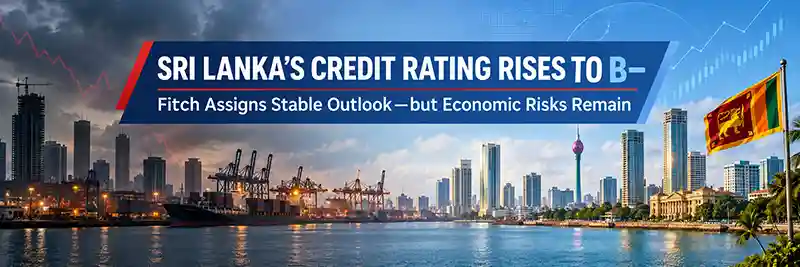
Fitch Ratings has upgraded Sri Lanka’s sovereign credit rating from CCC+ to B− with a Stable Outlook, citing macroeconomic stabilisation, structural reforms and improvements in fiscal and external balances. However, Fitch cautions that government debt, debt-servicing costs and foreign-exchange buffers remain significant vulnerabilities.
Fitch Ratings has upgraded Sri Lanka’s Long-Term Foreign- and Local-Currency Issuer Default Ratings from CCC+ to B−, assigning the country a Stable Outlook.
The rating action, announced on 22 September 2026, represents another important stage in Sri Lanka’s gradual recovery from its sovereign default and economic crisis.
Fitch said the upgrade reflects the implementation of macroeconomic stabilisation policies supported by structural reforms. According to the agency, these measures have reduced external financing risks and provided the country with a degree of resilience against economic shocks.
The agency highlighted sharp improvements in Sri Lanka’s fiscal and external balances, together with a modest rebuilding of foreign-exchange reserves.
Sri Lanka’s Latest Fitch Rating
Previous rating: CCC+
New rating: B−
Outlook: Stable
Announcement: 22 September 2026
What Does the B− Rating Mean?
A sovereign credit rating assesses a government’s capacity and willingness to meet its financial obligations.
Moving from CCC+ to B− indicates that Fitch considers Sri Lanka’s credit position stronger than it was at the previous assessment. It reflects reduced near-term default risk and improving economic and financial conditions.
However, B− remains below investment grade. It continues to indicate material credit risk and vulnerability to adverse economic, financial or political developments.
A Stable Outlook means Fitch does not currently expect to change the rating in the immediate future, provided economic policies and conditions broadly develop as anticipated. It does not guarantee that another upgrade will follow.
Stronger Revenue and Primary Surpluses
Fitch expects fiscal discipline and revenue mobilisation to help Sri Lanka maintain primary budget surpluses. A primary balance measures government revenue against expenditure before interest payments.
The agency forecasts a primary surplus of 2.6% of gross domestic product in 2026, compared with what it described as a record surplus of 5.4% in 2025.
Fitch expects primary surpluses to remain above 2% of GDP over the next few years, supported by revenue collection and expenditure restraint.
The agency said tax reforms and increased import duties connected with pent-up demand for imported vehicles have supported government revenue. Part of that revenue improvement may moderate as vehicle-import activity normalises.
Government Debt Is Declining—but Remains High
Fitch forecasts Sri Lanka’s government debt to fall from 96.7% of GDP in 2025 to 92.9% in 2026, before declining towards the low-80% range over the following five years.
Despite that projected improvement, the forecast level remains substantially higher than the median for other countries holding ratings in the broader B category.
The country’s interest costs also remain demanding. Fitch forecasts the interest-to-government-revenue ratio at 41% in 2026, down from 45.6% in 2025 and a peak of 76.3% in 2023.
According to Fitch, Sri Lanka’s limited fiscal space makes continued compliance with its fiscal and debt-management frameworks important.
Why Fitch Upgraded the Rating
- Improved fiscal and external balances
- Continued macroeconomic stabilisation
- Structural reforms supporting policy credibility
- Sustained government revenue growth
- Modest rebuilding of foreign-exchange reserves
- Reduced near-term external financing risks
Foreign-Exchange Reserves Continue to Recover
Fitch said financial support from the International Monetary Fund and other multilateral organisations continues to reduce near-term external financing pressure.
The agency forecasts Sri Lanka’s foreign-exchange reserves to reach US$7.7 billion by the end of 2026, equivalent to approximately 2.9 months of current external payments.
Nevertheless, Fitch described the country’s external buffers as thin. External debt repayments are expected to increase over the next five years, particularly after 2028.
The current IMF Extended Fund Facility is scheduled to end in March 2027. Fitch said a follow-on IMF arrangement was possible and could help support policy settings and provide an additional financing safeguard.
Energy Prices Put Pressure on the Current Account
Sri Lanka remains heavily dependent on imported energy and fertiliser, making the economy vulnerable to international price increases and supply disruptions.
Fitch expects higher energy costs to shift the current account into a deficit equivalent to 1.2% of GDP in 2026, following three years in which the country recorded an average surplus of 1.5%.
The agency said rising remittances were helping to offset some of these pressures. It expects the current account to move back towards balance in 2027 if the external energy shock eases.
Economic Growth Expected to Moderate
Fitch forecasts Sri Lanka’s economy to grow by 4.1% in 2026, compared with an average of 5% over the previous two years. The agency expects medium-term economic growth to remain slightly above 4%.
These figures are Fitch forecasts—not confirmed final economic results—and could change if domestic or international conditions deteriorate.
The agency identified continuing challenges in attracting foreign direct investment, expanding exports and revitalising state-owned enterprises. Sustained implementation of reforms could create stronger growth opportunities, while policy reversals could weaken the outlook.
Inflation and Cost-of-Living Pressures
Fitch forecasts headline inflation to average 6.3% in 2026, compared with negative inflation of 0.5% in 2025.
The agency connected the increase with international energy pressures and El Niño-related domestic conditions. It expects inflation to move back below the Central Bank of Sri Lanka’s 5% target during 2027.
A higher credit rating does not immediately reduce household expenses or guarantee lower prices. Its initial importance is mainly connected with sovereign risk, external financing and confidence in the country’s economic direction.
What Could Produce Another Upgrade?
Fitch identified two broad developments that could support a future rating increase:
- A substantial and sustained reduction in government debt and interest costs
- A large and durable increase in foreign-exchange reserves, supported by exports, remittances or other stable inflows
Faster economic growth and credible implementation of fiscal consolidation and debt-management strategies could also strengthen the country’s credit profile.
What Could Cause a Downgrade?
The rating could come under pressure if Sri Lanka experiences:
- Weaker fiscal discipline
- Reduced revenue mobilisation
- A slowdown in the decline of government debt
- Renewed external liquidity pressure
- Failure to build adequate foreign-exchange reserves
- Persistently large current-account deficits
- Major external shocks or policy reversals
Fitch also warned that external debt repayments will rise over the coming years, maintaining Sri Lanka’s exposure to financial and policy risks.
Important Perspective
The B− rating represents progress from CCC+, but Sri Lanka remains below investment grade. High public debt, elevated interest costs, limited reserve buffers and rising external repayments continue to create significant economic risks.
Why the Upgrade Matters
A stronger sovereign rating can improve international perceptions of Sri Lanka’s financial stability. It may support discussions with lenders, investors and development partners by demonstrating that the country’s near-term credit risks have eased.
The upgrade does not automatically guarantee foreign investment, cheaper government borrowing or immediate improvements in living standards. Those outcomes depend on continued reform implementation, political and institutional stability, export growth, reserve accumulation and responsible debt management.
The rating decision is therefore best understood as a positive but cautious assessment: Sri Lanka has moved further away from the most severe stage of its credit crisis, while substantial economic vulnerabilities remain.
