
From Kelaniya and Nagadeepa to Sri Pada, ancient chronicles and living Buddhist traditions preserve remarkable stories of sacred guardians, merit and protection
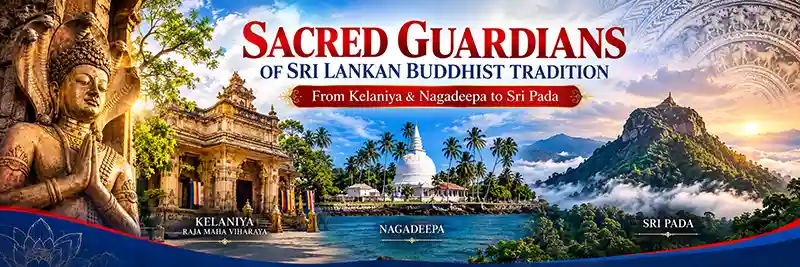
Sri Lanka’s Buddhist heritage contains a fascinating tradition of guardian deities and Nāga kings connected with sacred places including Kelaniya, Nagadeepa, Sri Pada, Dighavapi, Ruwanweliseya and other historic shrines. We explore what the ancient chronicles record, what belongs to later devotional tradition, and why these beliefs remain meaningful to many Buddhists today.
Across Sri Lanka, some of the island’s most revered Buddhist places are connected not only with stupas, relics, Bodhi trees and ancient kings, but also with centuries-old traditions concerning devas, Nāgas and guardian beings.
The Sinhala expression “සම්මා දිට්ඨික දෙවිවරු” — Sammā-Diṭṭhika Devivaru is commonly understood in Buddhist devotional culture as referring to deities regarded as having right or wholesome views and as being supportive of the Buddha’s teaching.
Alongside them, stories of Nāga kings occupy an important place in Sri Lanka’s Buddhist chronicles. The supplied Sri Lanka Directory graphic brings together this wider tradition by connecting guardian beings with a number of the country’s best-known sacred sites.
Yet there is an important distinction to make: Buddhist doctrine, ancient chronicle, later religious tradition and local folklore are not always the same thing.
Academic research into Sinhala Buddhist guardian-deity traditions notes that the composition and identities of guardian deities have changed across different periods and locations in Sri Lanka. Devotional practices involving gods have also developed alongside, rather than replacing, the central Buddhist refuge in the Buddha, Dhamma and Sangha
The Nāga Kings of Nagadeepa
One of the clearest Nāga narratives appears in the opening chapter of the Mahāvamsa.
According to the chronicle, during the Buddha’s second visit to Lanka, two Nāga rulers—Mahodara and Chulodara—were preparing for conflict over a precious jewelled throne. The Buddha is said to have intervened, brought the dispute to an end and preached to those assembled there.
This narrative forms a major part of the religious importance attributed to Nagadeepa.
Sri Lanka Tourism similarly identifies Nagadeepa as one of Sri Lanka’s important Buddhist sacred places and recounts the traditional story of the two Nāga kings and their dispute.
Beyond its religious significance, the story carries a powerful ethical theme: conflict is resolved through understanding rather than destruction.
That message remains relevant regardless of whether the Nāgas are interpreted literally as supernatural beings of Buddhist cosmology, as ancient communities or clans, or through a combination of religious and historical interpretations.
Maniakkhika Nāga King and Kelaniya
The connection between Kelaniya Raja Maha Viharaya and Maniakkhika Nāga King is particularly well established within Sri Lanka’s chronicle tradition.
The Mahāvamsa identifies Maniakkhika as a Nāga king connected with Kelaniya and as a relative of Mahodara. After witnessing the events at Nagadeepa, Maniakkhika invited the Buddha to visit his territory.
The chronicle then describes the Buddha’s third visit to Kelaniya at Maniakkhika’s invitation, accompanied by a community of monks.
Kelaniya Raja Maha Viharaya’s own historical account preserves the same tradition, stating that the Buddha’s third visit was made at the invitation of Maniakkhika and that a stupa was subsequently associated with the place where the Buddha was believed to have preached.
This makes Maniakkhika and Kelaniya one of the strongest historical-traditional connections represented in the SLD graphic.
Upulvan and the Protection of Lanka
Another important figure in Sri Lankan Buddhist tradition is Upulvan, subsequently closely identified with Vishnu in Sri Lankan religious culture.
Chapter VII of the Mahāvamsa contains a narrative in which the Buddha asks Sakka to protect Lanka, where his teaching would become established. Sakka then entrusts the guardianship of the island to a deity described as being the colour of the blue lotus—identified in the translation as Upulvan.
Over the centuries this helped establish the idea of Upulvan as one of Sri Lanka’s important guardian deities associated with the protection of the Buddha Sāsana.
Modern scholarship, however, points out that Sri Lanka’s guardian-deity tradition developed over long historical periods and that the identities grouped together as guardians were not completely fixed.
That is why it is better to describe Upulvan’s role as part of Sri Lanka’s Buddhist chronicle and devotional tradition rather than treating every later story associated with the deity as a single historically verifiable event.
Sumana Saman Deviyo and Sri Pada
Few relationships between a sacred landscape and a guardian deity are as deeply embedded in Sri Lankan Buddhist culture as the connection between Sumana Saman Deviyo and Sri Pada.
Sri Pada, or Adam’s Peak, is one of Sri Lanka’s most significant pilgrimage destinations. Buddhist tradition identifies the footprint at its summit with the Buddha, while the mountain is also sacred within Hindu, Muslim and Christian traditions under their respective interpretations.
Within Sinhala Buddhist tradition, Saman Deviyo is regarded as the guardian or presiding deity of Sri Pada and the surrounding Sabaragamuwa region. Scholarly research from the University of Colombo has also examined the continuing importance of Saman Deviyo within Sri Lankan popular Buddhist practice.
The pilgrimage itself continues to combine devotion to the Buddha with customs and rituals that have developed around the sacred mountain over many generations.
A Sacred Landscape Across Sri Lanka
The SLD graphic highlights a remarkable collection of sacred places:
Kelaniya Raja Maha Viharaya, Dighavapi, Thuparamaya, Kataragama Kiri Vehera, Nagadeepa, Sri Pada, Ruwanweliseya, Mirisavetiya, Tissamaharama and Seruwawila.
Many of these places belong to Sri Lanka’s most important networks of Buddhist pilgrimage.
The Solosmasthana, or sixteen sacred places, are traditionally regarded by Sri Lankan Buddhists as locations sanctified through connections with the Buddha. The Mahāvamsa explicitly refers to several locations associated with the Buddha’s journeys, while other sacred places entered the established Solosmasthana tradition through later Buddhist literature and devotional history.
Thuparamaya has additional importance as the first stupa traditionally said to have been constructed after the formal establishment of Buddhism under King Devanampiyatissa and to enshrine the Buddha’s right collarbone relic.
Dighavapi is similarly deeply connected with Buddhist tradition in eastern Sri Lanka, while Kiri Vehera at Kataragama remains one of the country’s major places of pilgrimage.
Seruwawila Mangala Raja Maha Viharaya has another major relic tradition: the stupa is associated with the enshrinement of the Buddha’s forehead relic and with King Kavantissa.
Sacred Places Highlighted in the SLD Graphic
These places belong to different periods and sacred traditions. The exact guardian-deity associations attached to individual sites may differ between chronicles, temple traditions and oral accounts.
What About the Exact Guardian Assigned to Each Stupa?
This is where responsible historical writing becomes especially important.
The graphic gives particular guardian deities or Nāga rulers for individual sacred locations. Some have strong chronicle support. Maniakkhika and Kelaniya, Mahodara and Chulodara at Nagadeepa, and the broader traditions concerning Upulvan and Saman can be traced through significant textual or established devotional sources.
Other claims—for example that a particular deity was specifically appointed as the continuing supernatural guardian of one particular later stupa—may come from local tradition, later chronicles, devotional works or oral teaching rather than from the earliest surviving historical text.
This does not make such traditions unimportant.
Rather, it shows how Sri Lanka’s Buddhist heritage has developed through several layers: canonical teaching, Pali chronicles, royal patronage, temple traditions, pilgrimage customs and popular devotion.
For a modern cultural publication, the fairest approach is to respect all of these while clearly indicating which kind of source is being discussed.
Why Do Buddhists Share Merit With Deities?
The Sinhala expression “පින් අනුමෝදන් කිරීම” — pin anumodan kirīma, often translated as sharing or inviting others to rejoice in merit, is familiar throughout Sri Lankan Buddhist practice.
Theravāda traditions developed several ways of understanding the dedication and sharing of meritorious actions. Research on Sri Lankan Buddhism notes that the practice developed historically and that rejoicing in another person’s wholesome action is an important element of the tradition.
Sri Lankan paritta traditions also contain verses inviting devas and Nāgas to rejoice in merit, together with aspirations that they protect the Buddha’s dispensation and the world.
This should not be misunderstood as suggesting that Buddhism teaches people to replace their own ethical responsibility with divine intervention.
The Buddhist principles of kamma, wholesome conduct, generosity, meditation and wisdom remain personal responsibilities. Devotional practices involving guardian beings exist within the wider religious culture surrounding those fundamental teachings.
More Than Mythology — A Part of Sri Lanka’s Living Heritage
The significance of these traditions reaches far beyond questions about supernatural beings.
They form part of the way generations of Sri Lankans have understood their sacred geography.
Kelaniya is remembered through Maniakkhika.
Nagadeepa recalls a conflict between Mahodara and Chulodara that ends peacefully.
Sri Pada combines pilgrimage with the protective presence of Saman Deviyo.
Ancient stupas preserve stories of kings, relics, monks, devotees and the communities that protected them across centuries.
Guardian-deity traditions therefore belong not only to religion but also to Sri Lankan literature, art, ritual, pilgrimage, architecture and collective memory.
For Sri Lankans living overseas, these stories can offer another connection to an island whose cultural landscape was shaped by more than two thousand years of Buddhist civilisation.
Preserving the Heritage Responsibly
Preserving these traditions also means telling their stories responsibly.
Religious belief deserves respect. Historical research deserves accuracy. Archaeological sites deserve protection.
Modern publishers, tour operators and social-media creators should therefore avoid presenting every later legend as proven history—or, at the opposite extreme, dismissing centuries of religious tradition simply because its purpose was devotional rather than archaeological.
Both can be understood within their proper contexts.
Sri Lanka’s sacred sites are extraordinary precisely because history, faith, architecture, literature and living practice meet in the same landscape.
And whether one approaches them as a Buddhist devotee, a historian, a traveller or a member of the Sri Lankan diaspora, the traditions of the devas and Nāga kings add another fascinating chapter to the story of the island.
