
BOI and NIRDC help HDDES Extracts advance Ingiriya expansion after resolving year-long legal and administrative delays
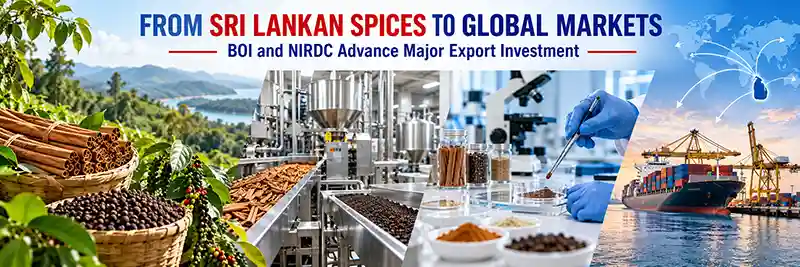
A $26.3 million foreign direct investment involving HDDES Extracts has progressed following coordination between Sri Lanka’s Board of Investment and the National Initiative for Research and Development Commercialisation. The planned Ingiriya facility will focus on high-tech spice processing, research, quality assurance and export-oriented production.
Sri Lanka has advanced a $26.3 million foreign direct investment that will support the establishment of a high-tech spice-processing industrial facility in Ingiriya.
HDDES Extracts Ltd. and the Board of Investment of Sri Lanka signed a supplementary agreement after legal and administrative issues that had delayed the project for more than a year were resolved.
The National Initiative for Research and Development Commercialisation, commonly referred to as NIRDC, facilitated the coordination in collaboration with the BOI.
Investment at a Glance
Investment value: US$26.3 million
Investor: HDDES Extracts Ltd.
Location: Ingiriya, near the Horana Investment Promotion Zone
Project: High-tech spice-processing industrial facility
Key component: Research, development and quality-assurance laboratory
Facilitating organisations: BOI and NIRDC
High-Tech Facility Planned for Ingiriya
The proposed facility will be established in Ingiriya, near the Horana Investment Promotion Zone.
According to the published announcement, the project will expand the operations of HDDES Extracts, an export-oriented Sri Lankan company involved in value-added spices, oleoresins, essential oils and related products.
The facility is also expected to include a laboratory complex dedicated to:
- Research and development in spice processing
- Product and process innovation
- Quality assurance
- Development of value-added export products
The project’s announced value is $26.3 million in foreign direct investment. The published information does not specify the construction timetable, production capacity, precise number of jobs or expected annual export revenue.
Those figures should therefore not be estimated until they are officially announced.
Administrative Barriers Resolved After More Than a Year
The project had reportedly faced legal and administrative issues for over a year.
Intervention by the NIRDC unit established at the Presidential Secretariat, together with the BOI, helped address those outstanding matters and enabled the investment to move forward.
Following the resolution of the issues, HDDES Extracts and the BOI signed a supplementary agreement covering the proposed expansion. www.ft.lk
The development illustrates the importance of coordinated investment facilitation when major projects encounter regulatory or administrative delays.
From Traditional Spices to Value-Added Exports
Sri Lanka is internationally recognised for agricultural products such as Ceylon cinnamon and other spices. However, greater economic value can be generated when locally sourced crops are processed into specialised ingredients and export products.
Oleoresins and essential oils are concentrated products used by international food, beverage, flavour, fragrance, cosmetic and related industries.
The proposed Ingiriya facility is therefore significant because it moves beyond exporting unprocessed agricultural commodities and focuses on higher-value manufacturing, research and quality assurance.
HDDES states that its product portfolio includes spices, natural extracts, Ceylon cinnamon, coconut products, essential oils, hydrolates and natural aromatic chemicals. The company also describes itself as a manufacturer and exporter of conventional and organic spices, oleoresins and essential oils. hddes.com
Potential Opportunities for Local Spice Suppliers
The project is expected to create new opportunities for Sri Lankan spice suppliers, including producers serving rural agricultural communities.
A larger value-added processing operation could increase demand for suitable local raw materials while connecting producers with an export-oriented industrial supply chain.
The announcement states that the project is expected to:
- Generate employment opportunities
- Create opportunities for local spice suppliers
- Strengthen rural incomes
- Increase value-added production
- Generate foreign-exchange earnings for Sri Lanka
These outcomes remain expected benefits of the proposed development. No quantified employment or farmer-income targets were included in the announcement.
Research and Quality Assurance at the Centre
The planned laboratory complex is an important component of the project.
International buyers generally require consistent product quality, food-safety compliance, technical documentation and traceability. Research and testing capabilities can help exporters develop products that meet specialised customer and market requirements.
Locating research, quality assurance and commercial processing within the same industrial development could support faster product development and more consistent export production.
However, specific laboratory technologies, certifications and research programmes connected with the new facility have not yet been publicly detailed.
Partnership Between HDDES Extracts, BOI and NIRDC
The supplementary agreement brought together the investor, Sri Lanka’s principal investment-promotion agency and a Government initiative focused on research and commercialisation.
Representatives identified in connection with the agreement included:
- K.A. Vimalaenthira Raja, Secretary to the Ministry of Trade, Commerce, Food Security and Cooperative Development and a BOI Board member
- V. Govindasamy, BOI Board member
- Gehan de Silva, Director of HDDES Extracts
- Mevan de Silva, Director of HDDES Extracts
- E.R.M. Idunil Gunathilaka, NIRDC Director of Investment
- Other officials representing the participating organisations
The reported involvement of NIRDC focused on coordinating the resolution of issues that had prevented the investment from proceeding.
Why the Investment Matters to Sri Lanka
The project combines several areas that are important to Sri Lanka’s economic development:
- Foreign direct investment
- Export-oriented manufacturing
- Agricultural value addition
- Rural supplier development
- Research and innovation
- Employment creation
- Foreign-exchange generation
Instead of relying solely on the export of raw spices, industrial processing enables Sri Lankan businesses to supply more specialised products to international markets.
The proposed facility may also help connect traditional agricultural production with modern research, manufacturing and export-quality systems.
Expected Areas of Impact
- Export-oriented value-added manufacturing
- Employment opportunities
- Demand for locally supplied spices
- Potential support for rural incomes
- Research and product development
- Foreign-exchange earnings
Moving from Approval to Implementation
The signing of the supplementary agreement represents an important step, but it should not be interpreted as confirmation that construction or commercial production has already begun.
Further announcements will be needed to establish:
- The construction commencement date
- The expected completion date
- Production capacity
- Number and type of employment opportunities
- Supplier-participation arrangements
- Export-market targets
- Environmental and operational approvals
- Research partnerships or certifications
Sri Lanka Directory will update readers when verified information about these stages becomes publicly available.
Information Note
The supplementary agreement has enabled the investment to progress. Publicly available information has not yet confirmed the construction commencement date, completion schedule, production capacity or exact number of jobs.
Sri Lanka Directory will update this report when further verified project details are announced.
A Positive Signal for Export-Oriented Investment
Resolving a delayed investment can send a constructive signal to other businesses considering projects in Sri Lanka.
The $26.3 million HDDES Extracts expansion is particularly relevant because it links investment with agricultural suppliers, industrial technology, research and exports.
If implemented as announced, the facility could strengthen Sri Lanka’s position as a source of value-added spice extracts and essential oils while creating wider opportunities within the local supply chain.

Comments