
World Bank Group and IFAD backing will connect farmers and agribusinesses with finance, technology, markets and higher-value supply chains
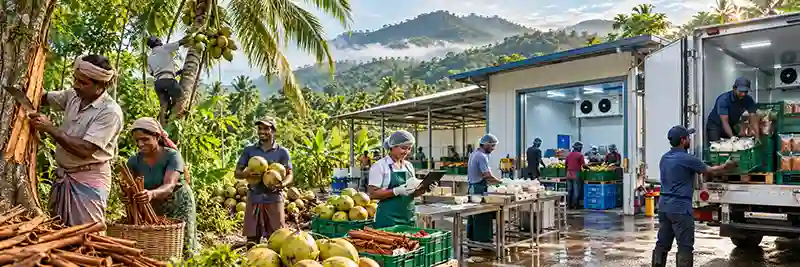
Sri Lanka has launched the AgriConnect Joint Implementation Plan, a coordinated programme intended to modernise the country’s agrifood sector, create better employment opportunities and strengthen national food security.
The Government launched the initiative in partnership with the World Bank Group and the International Fund for Agricultural Development (IFAD) on 30 October 2026.
Sri Lanka is the first South Asian country to formally join the global AgriConnect initiative. The programme aims to help 900,000 farmers obtain better access to agricultural value chains by 2030
Financing behind the programme
The World Bank Group states that the plan will be backed by US$550 million in its investments and US$115 million from IFAD. The initiative is also expected to help mobilise up to US$170 million in private capital during the next five years. worldbank.org
These figures need to be presented carefully. US$665 million represents the stated backing from the World Bank Group and IFAD. The additional US$170 million is a private-capital mobilisation target rather than confirmed public funding.
Some reports have rounded the overall package to US$840 million. However, the three officially stated components total US$835 million, including the private-capital goal. The more accurate headline therefore focuses on the programme and its 900,000-farmer target rather than describing the entire amount as committed funding.
Moving from commodities to higher-value production
AgriConnect is designed to help Sri Lanka move beyond primarily producing agricultural commodities and create more value through processing, technology, improved quality, market connections and stronger supply chains.
Prime Minister Dr. Harini Amarasuriya said farmers, fishers and rural communities should be recognised as partners in building a stronger, more productive and resilient economy.
The plan is aligned with the Government’s Public Investment Programme for 2026–2030 and the World Bank Group’s Country Partnership Framework.
Priority agricultural value chains
Finance, AgTech and better market access
The initiative will promote partnerships between farmers and agribusinesses while advancing agricultural finance, digital agriculture and AgTech.
Its scope also includes:
- Cold-chain development and connectivity
- Climate-resilient irrigation
- Agricultural skills and research
- Access to finance for farmers and agribusinesses
- Productive partnerships with commercially viable businesses
- Stronger links to domestic and international markets
- Increased value addition and export competitiveness
Agriculture and food processing collectively account for at least 15% of Sri Lanka’s gross domestic product, 30% of goods exports and one in every three jobs, according to the World Bank Group. worldbank.org
Opportunities for the Northern and Eastern Provinces
AgriConnect is expected to expand economic opportunities in regions that have historically received less investment, including the Northern and Eastern Provinces.
For smallholder farmers, the potential value lies not only in increasing production but also in gaining access to reliable buyers, finance, technology, storage and better-paying markets.
Agribusinesses may benefit from more organised supply chains, improved access to quality agricultural products and new financing arrangements. Technology companies, logistics providers, processors and exporters could also find opportunities within the programme’s wider agricultural ecosystem.
Implementation has already begun
Implementation has commenced through the Integrated Rurban Development and Climate Resilience Project, financed by the International Development Association.
That project connects commercially viable businesses led by smallholder farmers with improved financing and more profitable markets through productive partnerships.
The International Finance Corporation is complementing these activities by supporting the competitiveness and export potential of Sri Lanka’s cinnamon and coconut industries. Its work also includes expanding agribusiness access to finance through direct investment and risk-sharing facilities involving the financial sector. worldbank.org
Important details still to be announced
The official announcement does not provide a complete disbursement timetable or specify precisely how the World Bank Group and IFAD funding will be distributed among individual projects and agricultural sectors.
It also does not provide application procedures, farmer eligibility requirements or registration dates.
Farmers and businesses should therefore wait for announcements from the relevant Government agencies, World Bank Group and IFAD before applying for assistance or entering into financial arrangements claiming to be connected to AgriConnect.
Information for farmers and businesses
Registration dates, eligibility rules and sector-level funding arrangements have not yet been published. Confirm future opportunities through official Government, World Bank Group or IFAD channels.
A major opportunity—with results still to be measured
AgriConnect represents a significant effort to coordinate public investment, development finance and private-sector participation around Sri Lanka’s agrifood economy.
Its goals are ambitious: connect 900,000 farmers to stronger value chains, attract private investment, encourage agricultural technology and generate better rural employment by 2030.
The programme’s success, however, will ultimately be measured by practical outcomes—including whether smallholders gain reliable market access, rural businesses secure appropriate financing and agricultural communities receive lasting improvements in income and resilience.
