
Communities Face Crop Losses and Water Shortages as Reservoir Levels Fall and Heat Intensifies
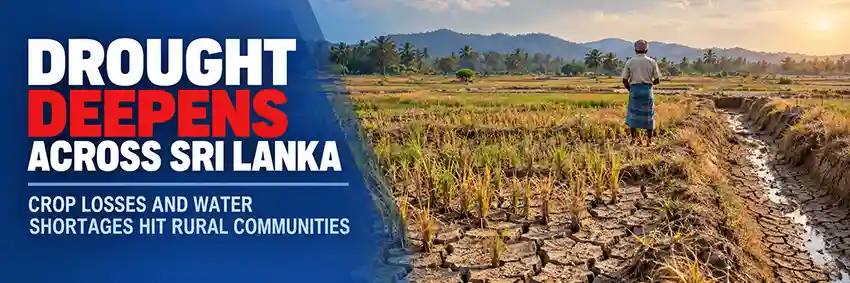
Months of inadequate rainfall have placed Sri Lankan farming communities, reservoirs and wildlife habitats under growing pressure. Authorities are monitoring water conditions while agricultural planners prepare for continuing El Niño-related uncertainty.
Months of inadequate rainfall and unusually hot conditions are placing increasing pressure on Sri Lanka’s farming communities, water resources and wildlife habitats.
Reservoir storage has declined, household wells have failed in some affected communities, crops have been damaged and wildlife authorities are supplying water to depleted watering holes, according to reporting published by the Associated Press on 8 October.
Medirigiriya in Sri Lanka’s North Central Province is among the areas highlighted as experiencing serious agricultural and water-related difficulties.
Farmers interviewed in the area reported crop failures, financial losses and increasing debt after insufficient rainfall affected paddy fields and household vegetable cultivation.
The Disaster Management Centre continued to list updated drought situation reports in early October, including a report dated 7 October 2026, indicating that the situation remains under official monitoring.
Sri Lanka Drought Situation at a Glance
These figures were reported by Associated Press on 8 October 2026 and may change as rainfall and reservoir conditions develop.
Reservoir and Groundwater Levels Under Pressure
Sri Lanka receives rainfall through two principal monsoon systems. The southwest monsoon, which generally operates between May and September, normally provides a substantial portion of the country’s annual rainfall.
However, rainfall during the 2026 southwest monsoon period was limited in many areas.
Associated Press reported that the combined storage of 74 reservoirs had remained at approximately one-third of capacity during recent weeks. The prolonged dry period has also affected groundwater, leaving some household wells without sufficient water.
Recent scattered showers have provided limited relief in parts of the country. Climate specialists cautioned that isolated rainfall would not immediately restore reservoirs and groundwater systems depleted over several months.
The Irrigation Department publishes daily storage information for major and medium-sized reservoirs, allowing the public and authorities to monitor changing water availability.
Farmers Face Crop Losses and Increasing Debt
Agricultural communities dependent on seasonal rainfall and irrigation tanks are particularly exposed to the drought.
In Medirigiriya, farmers reported damage to paddy, okra, eggplant and other crops. Some said they had borrowed money to prepare and cultivate their land but were unable to produce the harvests they expected.
One farmer featured in the AP report said crops planted across an eight-acre field had failed after approximately four months without sufficient rain. Another expected to harvest around 50 sacks of rice but reportedly collected only six.
These are individual accounts and should not be interpreted as national crop-loss statistics. However, they illustrate the severe financial consequences drought can create for farming households when cultivation loans, input expenses and family income depend on a successful harvest.
In areas where household wells have failed, residents have reportedly depended on water delivered by government agencies and charitable organisations.
El Niño May Be Contributing to Rainfall Disruption
Climate specialists have identified the current El Niño as one factor that may be contributing to Sri Lanka’s unusual rainfall conditions.
El Niño is a naturally occurring warming of parts of the Pacific Ocean that can alter weather patterns in different regions of the world.
Sri Lanka’s Department of Meteorology previously reported a high probability of El Niño conditions continuing during 2026. Its analysis noted that rainfall in Sri Lanka can depart from long-term monthly averages during El Niño years.
However, scientists have cautioned against attributing a specific drought entirely to climate change without sufficient evidence.
Climate scientist Gayana Krishanthi Hendawitharana of Sri Lanka’s Department of Meteorology told AP that additional evidence would be needed to determine the exact influence of climate change on the present event, although such extreme conditions have become more frequent in recent years.
El Niño, climate change and the immediate absence of monsoon rainfall should therefore not be treated as interchangeable explanations. El Niño is a natural climate pattern, while human-caused climate change can influence long-term temperature and weather risks.
Understanding the Climate Factors
Agricultural Authorities Plan for Continuing Uncertainty
Sri Lankan agricultural and water-management authorities have already been considering El Niño-related risks when planning the 2026/27 Maha cultivation season.
At a planning discussion involving the Agriculture Ministry, Department of Meteorology, Water Management Secretariat, Irrigation Department, Mahaweli Authority and other agencies, officials emphasised the importance of beginning cultivation according to technical recommendations and available water conditions.
The Water Management Secretariat advised that Sri Lanka could receive minimal rainfall between December and April. Authorities consequently discussed cultivation schedules intended to make better use of existing water resources.
The Government has said it expects approximately 800,000 hectares to be cultivated during the Maha season and that adequate seed paddy and fertiliser are available.
The 800,000-hectare figure is a Government cultivation objective—not a confirmed completed or harvested area. Actual cultivation and production will depend on weather, water availability and farmers’ ability to proceed.
Wildlife Competes for Shrinking Water Sources
The drought is also affecting Sri Lanka’s wildlife reserves.
AP reported that natural and artificial ponds in sections of Yala National Park had dried or contracted significantly. Elephants, spotted deer, water buffaloes, crocodiles and birds have been gathering around the remaining water sources.
Wildlife officials have used tankers, hoses and underground pipes to replenish some watering holes. Temperatures in affected areas were reported to have exceeded 35 degrees Celsius, increasing dehydration and heat stress while drying surrounding vegetation.
The Menik River, which supplies a significant part of Yala National Park, was still flowing when the area was observed. Therefore, it would be inaccurate to suggest that the entire park had lost its water supply.
Nevertheless, shrinking ponds and reduced vegetation can place greater pressure on animals and concentrate wildlife around fewer available water sources.
Why the Drought Matters Beyond Farming Areas
A prolonged agricultural drought can affect communities beyond the districts where crops are grown.
Reduced harvests may place pressure on rural incomes, food supplies and agricultural prices. Water shortages can also affect livestock, small businesses, tourism operations and communities located near wildlife habitats.
The final effects on national food production and consumer prices cannot be determined from the currently available information. Those outcomes will depend on the duration of the drought, future rainfall, water-management decisions and the performance of the Maha cultivation season.
Households and businesses should rely on notices from the Department of Meteorology, Disaster Management Centre, Irrigation Department, National Water Supply and Drainage Board and relevant local authorities for current information affecting their areas.
SLD Perspective
Sri Lanka’s present drought demonstrates how closely the country’s food production, rural livelihoods, water security and wildlife conservation are connected.
The accounts emerging from Medirigiriya show that drought is not simply a weather statistic. For affected farmers, insufficient rainfall can mean losing a season’s income while remaining responsible for loans and cultivation expenses.
Effective water management, reliable local information, climate-resilient farming practices and timely assistance for affected communities will become increasingly important if dry conditions continue.
Sri Lanka’s response should also recognise that farmers, households and wildlife may all depend on the same limited water resources during an extended drought.
Source Transparency
This article was independently written using information available on 8 October 2026.
The primary current report was published by the Associated Press following reporting in Medirigiriya and Yala National Park. Official context was obtained from Sri Lanka’s Disaster Management Centre, Department of Meteorology, Irrigation Department and Ministry of Agriculture, Livestock, Land and Irrigation.
The reservoir-capacity estimate, individual farmer experiences and wildlife observations are attributed to AP reporting. They have not been presented as independently measured national figures by Sri Lanka Directory.
Future rainfall conditions, final crop losses, national food-production effects and price impacts remain uncertain. No specific future outcome has been presented as established fact.
