
Pilotless two-seat eVTOL begins its testing phase as Sri Lanka explores future applications in tourism, transport, logistics and emergency services
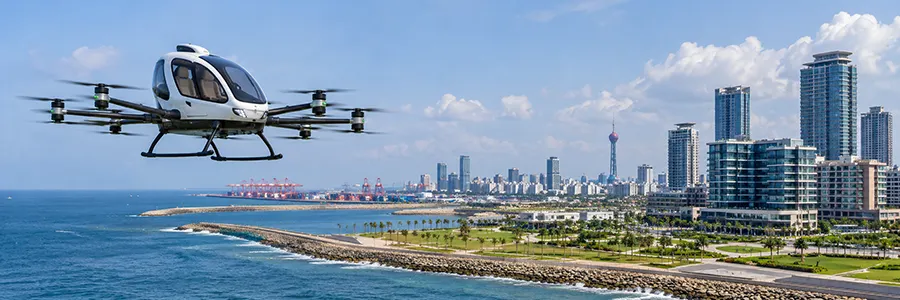
Sri Lanka has completed its first official public demonstration of an electric passenger-carrying drone at Colombo Port City, marking an early step towards evaluating pilotless air transport. The aircraft remains part of a testing programme, and commercial services have not yet received final approval.
Sri Lanka entered a new stage of aviation development on 11 November 2026 when an electric passenger-carrying drone completed an official public demonstration at Colombo Port City.
The aircraft used for the demonstration was identified as the EHang EH216-S, a pilotless electric vertical take-off and landing aircraft—commonly described as an eVTOL.
Minister of Ports and Civil Aviation Anura Karunathilaka and Deputy Minister Janitha Ruwan Kodithuwakku travelled aboard the two-seat aircraft during a short demonstration flight. The event introduced the Sri Lankan public to a technology being considered for future passenger transport, tourism, logistics and emergency-response operations.
What is the EHang EH216-S?
The EH216-S is a battery-powered aircraft designed to carry two passengers without an onboard pilot. It takes off and lands vertically, removing the need for a conventional runway.
According to manufacturer information, the aircraft follows predetermined flight routes using autonomous navigation and can be monitored through a central command-and-control system.
EHang lists a maximum design speed of 130 kilometres per hour, a range of 30 kilometres and a maximum take-off weight of 620 kilograms for the EH216-S. These are manufacturer specifications and do not represent routes or operating limits approved for commercial services in Sri Lanka. UAM –
Reports from the Colombo demonstration state that the aircraft contains 16 electric motors and propellers, 12 battery packs and multiple flight-control systems. www.newswire.lk
Why is it described as a passenger drone?
Although the aircraft is frequently called a “passenger drone” or “flying taxi,” it differs from the small remotely piloted drones commonly used for photography.
It belongs to the emerging advanced air mobility sector and has been developed specifically to transport people. Its electric motors enable vertical take-off and landing, while automated systems manage the flight instead of an onboard pilot.
The technology is being studied internationally as a possible solution for short-distance travel, aerial tourism, emergency response and transportation between congested urban locations.
Passenger drone or conventional aircraft?
Sri Lanka is evaluating a regulatory sandbox
The Civil Aviation Authority of Sri Lanka has held technical discussions with EHang and representatives from several relevant institutions about introducing eVTOL operations safely.
The discussions have addressed certification, licensing, airspace integration, security, infrastructure, safety oversight and the possible establishment of an eVTOL regulatory sandbox.
A regulatory sandbox is a controlled environment in which new technology can be tested while authorities develop appropriate rules and assess operational risks.
The Civil Aviation Authority has said that any potential adoption must follow aviation-safety standards, regulatory requirements and international best practices. caa.lk
Testing does not mean commercial services have begun
The Colombo Port City demonstration must not be interpreted as the launch of an operating passenger-drone service.
Testing is expected to continue for approximately five to six months. Commercial operations would depend on successful technical and safety assessments, appropriate infrastructure and approval from the responsible authorities.
EHang previously stated that its proposed commercial operations in Sri Lanka remained subject to local laws, safety assessments, operational preparations and regulatory approval. ehang.com
No confirmed public booking system, ticket price, permanent route network or commercial commencement date has been announced by the Sri Lankan authorities.
This is a trial—not a public air-taxi service
The demonstration allows Sri Lanka to evaluate the aircraft and its supporting systems. Passengers cannot currently book routine commercial flights, and final routes, prices and operating rules have not been announced.
Potential tourism opportunities
Passenger-carrying eVTOL aircraft could eventually create a new category of visitor experience in Sri Lanka.
Possible applications discussed by officials and industry representatives include aerial tourism, travel between airports and urban centres, and connections to selected visitor destinations.
However, routes involving environmentally or culturally sensitive locations would require careful assessment. Noise, wildlife protection, community impact, airspace safety and heritage-site regulations would all need to be considered before tourism operations could be approved.
The aircraft’s limited manufacturer-stated range also means that any proposed routes would depend on suitable vertiports, charging facilities and operational planning.
Possible transport and emergency uses
Beyond tourism, eVTOL technology could potentially support:
- Short-distance urban passenger transportation
- Connections between airports and city centres
- Emergency medical operations
- Delivery of essential supplies to difficult-to-access areas
- Logistics and time-sensitive cargo movement
- Disaster-response and assessment activities
These remain potential applications rather than confirmed Sri Lankan services.
Infrastructure and safety will determine the future
Introducing passenger drones requires more than importing an aircraft.
Sri Lanka would need suitable take-off and landing locations known as vertiports, charging infrastructure, maintenance systems, emergency-response procedures and trained operational personnel.
Authorities would also need to determine how the aircraft will share airspace with conventional aeroplanes, helicopters, military operations and other drones.
Reliable communications, weather monitoring, passenger protection, cybersecurity and independent safety oversight would be essential components of any future commercial system.
What must happen before public services begin?
Reported disagreement over Port City permission
The Morning reported that the demonstration encountered an administrative disagreement concerning permission from the Colombo Port City Economic Commission.
According to that report, the Civil Aviation Authority maintained that aviation and security clearances had been obtained, while a question arose regarding the Commission’s permission for activities within Port City.
This account should be treated as an attributed media report. SLD has not independently verified the internal communications between the institutions concerned. The Morning
The reported issue demonstrates why clearly defined responsibilities and coordination between government institutions will be important when Sri Lanka evaluates unfamiliar aviation technologies.
A promising development that still requires careful evaluation
The first public passenger-drone demonstration is a notable technological milestone for Sri Lanka.
It provides an opportunity for regulators, aviation specialists, tourism authorities, investors and the public to examine how electric air mobility could operate within the country.
Nevertheless, a successful demonstration flight is only the beginning. The technology’s future in Sri Lanka will depend on transparent regulations, proven safety, viable operating costs, suitable infrastructure and responsible environmental planning.
For now, the EH216-S should be understood as an aircraft undergoing evaluation—not as a commercially available Sri Lankan air-taxi service.

Comments