
From Passion to Precision: A Decade of Sri Lankan Aerospace Innovation
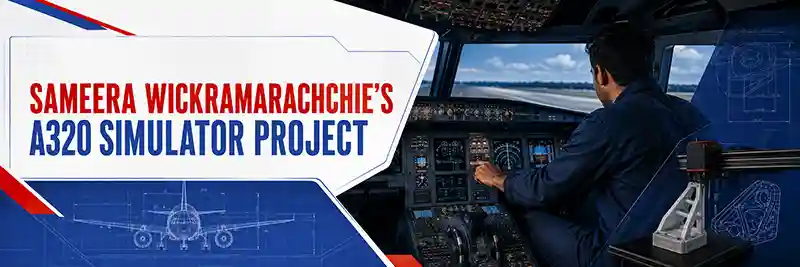
Sri Lankan aerospace specialist Sameera Wickramarachchie, referred to as “SIM SAM,” has been developing a full-scale Airbus A320 flight-simulator project since 2016, reportedly designing, engineering, 3D-modelling and manufacturing many of its major components himself.
A striking example of Sri Lankan engineering ingenuity is attracting attention online after new details emerged about Sameera Wickramarachchie, an aerospace professional who has spent years developing a full-scale Airbus A320 flight-simulator project in Sri Lanka.
The core story is substantially supported by the public evidence reviewed by Sri Lanka Directory. A recent account by aviation professional Dr Upuli Warnakula states that Wickramarachchie has been working on the simulator since 2016, personally designing, engineering, 3D-modelling and manufacturing many of its major components rather than simply assembling a collection of ready-made cockpit modules.
According to that account, the work extends from cockpit panels and flight controls to structural parts and numerous custom components. Perhaps most unusually, Wickramarachchie is also reported to have built his own 3D printers to manufacture components required for the simulator.
Recent accounts from participants who have used Wickramarachchie’s simulation facility provide additional evidence that the project is operational. One participant described carrying out simulated pre-flight procedures, take-off, navigation and landing while learning about aircraft systems and flight operations.
The available evidence therefore supports the existence of the A320 simulator and Wickramarachchie’s long-running engineering work. However, SLD has not found evidence showing that the simulator is certified or approved by Airbus, qualified by a civil-aviation regulator as a professional full-flight simulator, or equivalent to a certified Level D training device. Those are separate technical and regulatory classifications and should not be implied by the phrase “full-scale.”
Building far more than a ready-made cockpit
What makes the project particularly interesting is the method behind its construction.
Many enthusiast flight simulators are created by purchasing commercially available panels, controls, displays and cockpit sections before integrating them with simulation software. The account of Wickramarachchie’s project describes a substantially different approach.
According to Warnakula, almost every major component was personally designed, engineered, 3D-modelled or manufactured by Wickramarachchie, including cockpit panels, flight controls, structural elements and numerous custom parts.
That does not necessarily mean every electronic component, computer, display, sensor or software element was manufactured from raw materials by Wickramarachchie. “Built from scratch” is therefore best understood as describing the extensive original design, fabrication and integration work behind the overall simulator rather than a claim that literally every component was produced by one individual.
The reported construction of his own 3D printers adds another engineering layer. Rather than relying entirely on commercially available manufacturing equipment, the project reportedly involved developing tools capable of producing some of the custom parts required for the simulator.
From aerospace knowledge to practical engineering
Warnakula identifies Wickramarachchie as holding a BSc in Aerospace Technology, describing the simulator as the result of combining academic knowledge with practical engineering, fabrication and repeated problem-solving.
Public professional references from Sri Lankan educational and aviation events have also identified Wickramarachchie as a Senior Program Manager – Aerospace and Defence at IFS. He was listed in that capacity among aviation professionals participating in the AEROminds programme and has appeared in more recent professional-development activities involving university students.
His simulator project appears to bring together several engineering disciplines: mechanical construction, electronics, aircraft-system representation, control interfaces, computer simulation, 3D modelling, fabrication and systems integration.
That multidisciplinary character is significant. Reproducing the working environment of a modern commercial-aircraft flight deck involves much more than making something that visually resembles a cockpit.
Controls, switches, displays and software must interact in a way that creates a convincing simulation of aircraft operation.
Students have already experienced the simulator
The project is not simply an unfinished workshop display.
Recent participant accounts describe attending practical sessions at Sameera Wickramarachchie’s simulation facility and using the simulator through different phases of simulated flight.
One participant described working through pre-flight procedures, take-off, real-time navigation and landing while gaining practical exposure to aircraft controls and aviation systems.
Other public accounts similarly thank Wickramarachchie for providing flight-simulation experience and technical guidance to university students.
These reports provide useful independent corroboration that an operational simulator facility exists and that it is being used for educational and experiential activities.
They do not, however, establish that the system is approved for airline pilot licensing, type-rating credits or other regulated flight-training purposes.
The project continues beyond the A320
The A320 simulator apparently represents only one stage of Wickramarachchie’s work.
Warnakula’s recent account states that he is now developing helicopter simulators and several other simulator projects, suggesting that the engineering platform and experience gained during the A320 project are being extended into other aviation applications.
Developing different simulator types could involve substantially different flight controls, cockpit layouts and aircraft dynamics, particularly when moving from fixed-wing aircraft to helicopters.
If those projects continue to develop, they could provide an interesting example of locally developed simulation engineering in Sri Lanka.
Why this achievement matters
Flight simulation sits at the intersection of aerospace engineering, software, electronics, human-machine interaction and education.
Commercial aviation organisations use highly sophisticated certified simulators for pilot training because realistic simulation allows crews to practise procedures and abnormal situations without placing an actual aircraft at risk.
A privately developed simulator should not automatically be compared with those certified multi-million-dollar training systems. But independent engineering projects can still have considerable educational value.
They can allow students to understand cockpit layouts, flight-control logic, aircraft instrumentation and systems integration in a much more tangible way than classroom instruction alone.
For Sri Lanka, the project also demonstrates the possibilities created when engineering knowledge is combined with local fabrication and rapid prototyping.
Building custom parts with 3D modelling and additive-manufacturing techniques can reduce dependence on expensive specialist components during prototype development and allow engineers to repeatedly redesign parts until they perform as intended.
A decade of testing, redesign and persistence
Projects of this scale rarely progress in a straight line.
Warnakula, who says she personally witnessed the development journey, described years of testing, failures, redesigns, problem-solving and persistence behind the simulator.
That aspect may ultimately be as important as the finished cockpit itself.
Engineering innovation often depends upon iterative development: designing a component, testing it, discovering weaknesses, modifying the design and repeating the process until it performs reliably.
Wickramarachchie’s project appears to illustrate that process on an unusually ambitious scale for an independently developed Sri Lankan aviation simulator.
What SLD could not independently verify
Sri Lanka Directory did not locate public technical documentation establishing the simulator’s exact physical dimensions, complete hardware specification, software architecture, total development cost or percentage of components manufactured directly by Wickramarachchie.
SLD also found no evidence reviewed for this report showing that Airbus formally participated in, endorsed or certified the project.
Similarly, no evidence located by SLD establishes that the simulator has been approved by the Civil Aviation Authority of Sri Lanka or another regulator as a certified flight-training device that can provide recognised pilot-training credits.
The term “full-scale Airbus A320 simulator” should therefore be understood as the description being used for the independently developed cockpit simulation project—not as a regulatory certification category.
This distinction does not diminish the engineering accomplishment. It simply separates an impressive independently developed simulator from the highly regulated category of certified commercial aviation training devices.
The SLD Perspective
Sameera Wickramarachchie’s A320 simulator project is an encouraging example of what can emerge when technical knowledge, experimentation and long-term determination come together.
The most compelling part of the story is not that Sri Lanka has somehow produced a replacement for an Airbus-certified airline simulator. There is no evidence supporting such a claim.
The achievement is that a Sri Lankan aerospace professional has reportedly spent around a decade designing, manufacturing, testing and integrating a complex full-scale cockpit simulation project, while developing many of its components through his own engineering and fabrication work.
Its educational use is already visible in the experiences shared by students who have visited the facility.
Sri Lanka has produced talented engineers, aviation professionals, software specialists and technical innovators across the world. Projects such as this show the potential that exists when that knowledge is transformed into practical experimentation at home.
Sri Lanka Directory congratulates Sameera Wickramarachchie — “SIM SAM” — on the progress of the project and looks forward to seeing how his A320, helicopter and future simulator developments evolve.
Source Transparency
Sri Lanka Directory prepared this article using information publicly available up to 1 September 2026.
The principal claim is supported by a recent public account from aviation professional Dr Upuli Warnakula, who states that she personally witnessed Wickramarachchie’s project and describes its development since 2016, its custom-manufactured components and his use of self-built 3D printers.
Recent public accounts from participants provide separate corroboration that Wickramarachchie operates a flight-simulation facility and that users have carried out simulated pre-flight, take-off, navigation and landing procedures there.
Public educational-event records have identified Wickramarachchie professionally as Senior Program Manager – Aerospace and Defence at IFS.
