
New Gazette rules introduce strict visitor controls to protect Ella’s extraordinary underground blue-water attraction while preparing it for regulated tourism
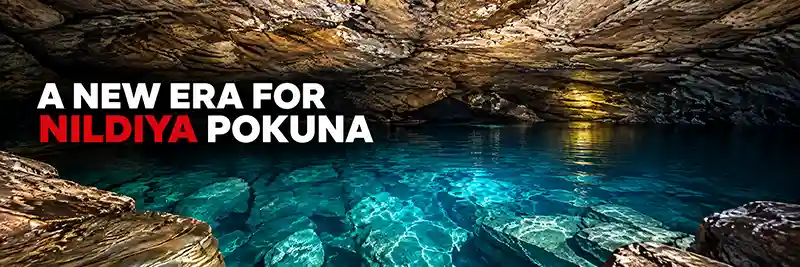
Sri Lanka has introduced new regulations for Nildiya Pokuna, the remarkable underground natural pool inside the Ravana Ella Sanctuary near Ella, placing tourism activities under Wildlife Conservation supervision. The new rules prohibit entering the water, strengthen visitor-safety requirements and introduce controls designed to protect the fragile cave environment for future generations.
Hidden beneath the mountains near Ella lies one of Sri Lanka’s most unusual natural attractions: Nildiya Pokuna, an underground blue-water pool located within a cave complex in the Ravana Ella Sanctuary.
Long known among adventure travellers for its dramatic underground setting and exceptionally clear water, the site has increasingly attracted both Sri Lankan and international visitors.
Now, Nildiya Pokuna is entering a new phase.
Sri Lanka has introduced special regulations intended to bring tourism activities at the site under formal supervision while protecting the sensitive natural environment. Environment Minister Dr. Dammika Patabendi was reported to have signed the relevant Extraordinary Gazette notification on 7 September 2026, following earlier Cabinet approval for the regulations.
The change is significant because the Government is attempting to balance two competing priorities: allowing people to experience one of Sri Lanka’s increasingly popular natural attractions while preventing uncontrolled tourism from damaging the very environment visitors come to see.
A Rare Natural Attraction Inside the Ravana Ella Sanctuary
Nildiya Pokuna is situated within an internal cave complex in the Karandagolla Grama Niladhari Division, in the Ella Divisional Secretariat area of the Badulla District.
The Cabinet Office describes it as a rare natural water source whose unusual geographical characteristics have made it popular among local and foreign tourists.
Unlike a conventional lake, waterfall or swimming attraction, the experience is closely connected with the surrounding underground cave environment. That makes both visitor safety and environmental protection especially important.
Growing popularity can create economic opportunities for communities surrounding Ella, but increasing numbers of visitors can also bring littering, damage to geological formations, pollution, noise and unsafe behaviour into a particularly sensitive environment.
The Government’s approach is therefore moving away from relatively informal access toward a managed tourism model under the Department of Wildlife Conservation.
Nildiya Pokuna: What Visitors Need to Know
New regulations are designed to protect the underground ecosystem while improving visitor safety.
Visitor reminder: Wildlife Conservation safety instructions and authorised access requirements should always be followed when visiting the site.
The restrictions reported from the Gazette include a prohibition on entering the water; depositing waste, detergents or chemicals; creating excessive noise; using musical instruments or amplified sound; lighting fires; smoking; consuming alcohol or illegal drugs; moving rocks; and making inscriptions on cave surfaces. Children under 10 are prohibited from entering, while those aged 10–18 must be accompanied by a guardian.
Why Sri Lanka Introduced the New Regulations
The decision did not emerge overnight.
The Government appointed a technical committee involving university academics and representatives of relevant state institutions to study Nildiya Pokuna and recommend how tourism could be managed without sacrificing conservation.
According to the official Cabinet decision, the committee submitted a study report and regulations based on those recommendations were subsequently examined and confirmed by the Legal Draftsman. Cabinet then approved the Environment Minister’s proposal to publish the regulations under the Fauna and Flora Protection Ordinance.
That process is important.
Instead of treating Nildiya Pokuna simply as another sightseeing location, the Government has recognised that its popularity must be managed around the site’s ecological and geological sensitivity.
Swimming in Nildiya Pokuna Is No Longer Part of the Visitor Experience
One of the most important changes concerns the feature that helped make Nildiya Pokuna famous online: its striking blue water.
Under the newly reported regulations, visitors cannot enter the water.
That means images or social-media videos showing people swimming or bathing in the underground pool should not be interpreted as representing what visitors will now be permitted to do under the new management regime.
From a conservation perspective, the restriction reduces the possibility of contamination while also helping authorities control safety risks in an underground location.
For tourism businesses promoting Nildiya Pokuna, this also creates an important responsibility: future advertising should describe it as an underground natural attraction and guided cave experience, rather than promoting swimming in the pool.
A Controlled Reopening Is Being Planned
Reports published on 7 September indicate that the Ministry intends to reopen Nildiya Pokuna to visitors under a more organised Government-supervised system.
Current plans reportedly include an authorised-guide system, controlled visitor numbers, limited time at the attraction and formal ticketing. Hiru News reported that approximately 60 guides, mainly from the surrounding area, were undergoing training, while the Ministry was considering a limit of around 300 visitors per day, with approximately one hour allocated to each visitor.
The same report indicated that reopening is planned for October 2026.
These operational details should be treated as the current reopening plan rather than permanent guaranteed conditions, because visitor limits, fees, opening dates and procedures may still be adjusted before or after operations begin.
From Uncontrolled Access to Managed Eco-Tourism
Current plans point toward a smaller, controlled visitor experience designed around conservation and safety.
Important: Visitor numbers, reopening dates, guide arrangements and ticket prices are operational plans reported on 7 September 2026 and should be reconfirmed before travel.
Responsible Tourism Could Strengthen Ella’s Appeal
Ella is already one of Sri Lanka’s best-known hill-country destinations, and the rising profile of Nildiya Pokuna adds another dimension to the region’s tourism offering.
However, the long-term value of an attraction such as Nildiya Pokuna cannot be measured simply by the number of people entering the cave.
A successful management system needs to protect the underground environment, minimise pollution, prevent damage to geological formations, maintain safe access and ensure that the surrounding community also receives meaningful economic benefits.
The reported plan to train guides from the surrounding area is particularly relevant in this respect. Well-managed nature tourism can create opportunities for local guides, accommodation providers, transport operators, restaurants and other small businesses while ensuring that visitor activity remains controlled.
For Sri Lanka’s wider tourism sector, Nildiya Pokuna could demonstrate how a growing natural attraction can move from informal popularity toward a more professional eco-tourism and conservation model.
What Visitors Should Do Before Planning a Trip
Travellers should avoid relying solely on older travel blogs, social-media videos or tour advertisements.
Some material published before the new regulations shows activities—especially entering or swimming in the water—that are now prohibited under the reported rules.
Visitors should check the latest instructions from the Department of Wildlife Conservation or Ministry of Environment, use authorised access arrangements, follow guide instructions and respect all restrictions within the sanctuary.
The underground setting can also present physical challenges that differ substantially from visiting a conventional tourism attraction. Regulations and official safety directions should therefore be treated as part of the experience rather than as optional restrictions.
Conservation Must Come Before Social-Media Popularity
Nildiya Pokuna’s visual appeal has helped make it increasingly prominent online.
That visibility can be valuable for Sri Lanka tourism, but environmentally sensitive locations can also become vulnerable when social-media popularity grows faster than infrastructure and regulation.
The new approach provides Sri Lanka with an opportunity to position Nildiya Pokuna not merely as a dramatic place to photograph, but as an example of responsible nature-based tourism.
The most valuable image from Nildiya Pokuna should ultimately be one that can still be experienced by visitors many decades from now.
The SLD Perspective
Nildiya Pokuna represents exactly the type of attraction that demonstrates how extraordinarily diverse Sri Lanka’s tourism offering can be.
Within a relatively small island, travellers can experience beaches, wildlife, ancient cities, rainforests, mountains, waterfalls and, in this case, a remarkable underground natural water source.
But growing popularity also creates responsibility.
Sri Lanka Directory welcomes efforts to make Nildiya Pokuna safer and more professionally managed while placing environmental conservation at the centre of the visitor experience.
Prohibiting swimming may disappoint travellers who encountered older photographs and videos of people inside the water, but protecting a fragile natural resource should carry greater weight than maintaining an activity simply because it became popular online.
If the new system is implemented consistently—with trained guides, transparent visitor procedures, sensible capacity limits and meaningful local-community participation—Nildiya Pokuna could become a strong example of how Sri Lanka can grow tourism without sacrificing the natural assets on which tourism depends.
For travellers, the message is equally simple:
Visit. Explore. Photograph. Respect. Preserve.
And for Sri Lankan tourism businesses, the opportunity is to promote Nildiya Pokuna responsibly—not merely as another attraction, but as one of the island’s remarkable natural environments deserving long-term protection.
Follow Sri Lanka Directory News for verified updates on Sri Lankan tourism, destinations, businesses, achievements and developments connecting Sri Lanka with the world.
