
World Tourism Day Programme Highlights AI-Powered Ideas for Sri Lanka’s Visitor Economy
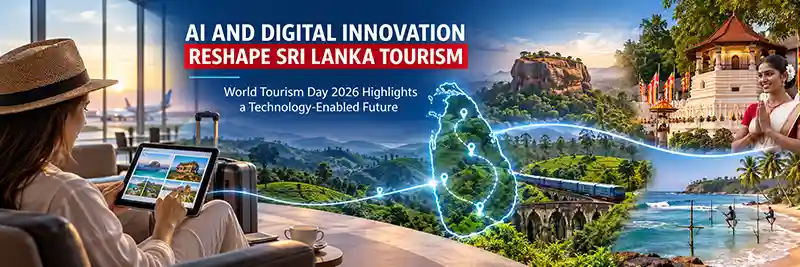
Sri Lanka’s national World Tourism Day 2026 programme highlighted how artificial intelligence and digital technology could improve visitor experiences, destination management and tourism services while supporting local innovators and entrepreneurs.
Sri Lanka has placed artificial intelligence and digital transformation at the centre of discussions about the future of its tourism industry, with government, business, academic and technology representatives gathering in Colombo for the country’s national World Tourism Day 2026 programme.
The Sri Lanka Tourism Development Authority hosted the national celebration at the Taj Samudra in Colombo on 25 September 2026. The programme was organised under the theme “Digital Agenda and Artificial Intelligence to Redesign Tourism.”
The event examined how digital technologies and artificial intelligence could be used to improve visitor experiences, strengthen destination management, enhance tourism services and create new opportunities for businesses and entrepreneurs.
Representatives from the Government, tourism industry, private sector, universities and technology and innovation communities participated in the programme.
World Tourism Day 2026: Key Details
- National event: 25 September 2026
- Venue: Taj Samudra, Colombo
- Organiser: Sri Lanka Tourism Development Authority
- Theme: Digital Agenda and Artificial Intelligence to Redesign Tourism
- Main focus: AI, digital transformation, innovation and tourism entrepreneurship
Tourism Start-Up Competition Attracts 52 Applications
A major feature of the programme was the Tourism Start-Up Competition 2026, conducted under the theme “AI-Driven Innovation for the Future of Tourism.”
According to the published event information, the competition received 52 applications across two divisions: a tertiary-level category and a commercial-level category.
Following an evaluation process, 25 applications were selected for the final stage. The finalists presented their proposed AI-powered tourism solutions to an expert panel.
Six winners from each category were subsequently selected and recognised during the national celebration. Their names and full project descriptions were not included in the published report, so those details should not be stated unless subsequently released by SLTDA or another authorised source.
The competition provided a platform for students, entrepreneurs and tourism innovators to demonstrate ideas that may contribute to the industry’s future development.
How Digital Technology Could Support Tourism
Digital technology already influences how travellers research destinations, compare accommodation, make reservations, navigate unfamiliar locations and communicate with tourism providers.
Artificial intelligence can potentially support areas such as personalised travel information, multilingual assistance, customer-service automation and analysis of visitor demand. However, the precise technologies, projects and implementation schedules that Sri Lanka Tourism may adopt were not announced at the event.
The programme instead focused on encouraging an innovation-oriented environment in which tourism authorities, businesses, universities and technology specialists can work together.
This distinction is important: the event presented a direction for tourism innovation and recognised proposed solutions, but it did not announce the nationwide deployment of a particular AI platform.
What This Means for Tourism Businesses
The programme signals increasing attention to digital capability across Sri Lanka’s visitor economy. Hotels, restaurants, tour operators, transport providers and destination businesses may benefit from monitoring future SLTDA announcements concerning:
- Digital promotion and online visitor engagement
- AI-assisted customer communication
- Tourism start-up and innovation programmes
- Destination-management technology
- Training and collaboration opportunities
No general application process, funding programme or implementation timetable was announced in the published event report.
Tourism Arrivals Provide an Important Economic Context
The technology discussion comes as Sri Lanka continues working to strengthen its international visitor economy.
Official information released on 25 September showed that Sri Lanka recorded 1,642,215 tourist arrivals between 1 January and 20 September 2026. During the first 20 days of September, the country received 107,093 visitors.
India was the leading source market during that September period, contributing 32,536 arrivals. The United Kingdom contributed 7,906 visitors, while Australia contributed 7,393.
These figures help explain why improvements to tourism promotion, visitor services and destination management remain economically significant. They do not, however, establish that the World Tourism Day programme or its AI competition caused the reported arrival numbers.
Opportunities Must Be Matched by Responsible Implementation
The use of AI in tourism can create opportunities, but responsible implementation will also require attention to the accuracy of visitor information, personal-data protection, accessibility and the ability of smaller businesses to participate.
Tourism operators may also need practical training before advanced digital tools can be used effectively in everyday business operations.
The World Tourism Day programme brought public institutions, private businesses, academics and technology specialists into the same discussion. Continued cooperation among these groups will be important if proposed ideas are to develop into services that provide measurable value to visitors and local tourism businesses.
Building a More Connected Visitor Economy
Sri Lanka’s combination of natural attractions, cultural heritage, wildlife, cuisine and hospitality gives the country a broad tourism offering. Digital tools can help travellers discover those experiences and connect with legitimate local service providers.
For Sri Lankan tourism businesses, especially small and medium-sized enterprises, stronger digital visibility may create opportunities to reach international travellers more directly. Technology alone, however, cannot replace service quality, reliable information, environmental responsibility and authentic visitor experiences.
The national World Tourism Day 2026 programme represents a public commitment to discussing these changes and encouraging local innovation. The next important development will be whether selected concepts progress into practical solutions and whether future programmes provide clear opportunities for tourism businesses throughout the country.
SriLankaDirectory.com will continue to monitor official announcements concerning the competition winners, proposed AI solutions and future tourism digitalisation programmes.
