
Foreign Investments and Mega Development Projects Are Reshaping Sri Lanka’s Future
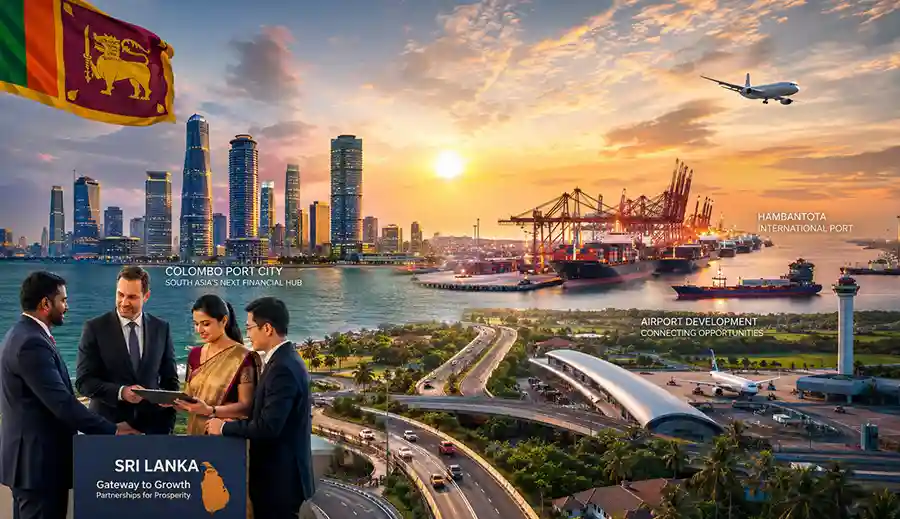
After years of economic uncertainty, Sri Lanka is once again becoming a major talking point among international investors, infrastructure developers, logistics companies, and global businesses. From the rapidly expanding Hambantota Port to the ambitious Colombo Port City project, the country is entering a new phase of transformation that could redefine its economy for decades.
Massive foreign direct investments (FDIs), strategic infrastructure projects, airport redevelopment plans, and logistics expansion are now positioning Sri Lanka as a growing hub in the Indian Ocean region.
For business leaders, entrepreneurs, investors, and ordinary Sri Lankans, the big question is no longer whether development is coming — it is how fast Sri Lanka can capitalize on these opportunities.
Hambantota Is No Longer Just a Port City
One of the most discussed development regions in Sri Lanka today is Hambantota.
What was once criticized as an underutilized investment is now rapidly evolving into a major logistics and industrial hub. Recent developments suggest that Hambantota is becoming one of the most strategically important economic zones in South Asia.
According to recent reports, Hambantota International Port has announced an investment exceeding USD 100 million to expand container handling operations and terminal capacity. New high-capacity cranes and advanced logistics infrastructure are expected to significantly increase the port’s operational capabilities.
This expansion is important because Hambantota sits near one of the busiest global shipping routes in the world. Thousands of cargo vessels pass close to Sri Lanka every year, making the island a natural maritime gateway between Asia, the Middle East, and Africa.
The growth of Hambantota could lead to:
- Increased shipping and logistics activity
- Growth in export industries
- New industrial zones
- Manufacturing opportunities
- Employment generation
- Stronger foreign exchange earnings
Experts believe that if properly managed, Hambantota could eventually become a major regional logistics and transshipment center.
Mattala Airport Could Finally Come Alive
For years, Mattala Rajapaksa International Airport was labeled one of the world’s least utilized airports.
But that story may soon change.
Sri Lanka has officially reopened investment opportunities for Mattala Airport, inviting both local and foreign investors to participate in aviation, cargo, logistics, hospitality, and industrial projects.
Authorities are promoting Mattala as a future aviation and logistics hub connected directly with Hambantota Port. The long-term vision includes:
- Cargo and freight operations
- Aircraft maintenance facilities
- Manufacturing and industrial parks
- Warehousing and logistics centers
- Tourism and hospitality development
- Renewable energy investments
This airport-port combination could become a powerful economic corridor for southern Sri Lanka.
If international partnerships materialize successfully, the Hambantota-Mattala region could see a major economic revival over the next decade.
Colombo Port City Continues to Attract Global Attention
Another major development transforming Sri Lanka is the Colombo Port City project.
Built on reclaimed land beside Colombo, Port City is designed to become a modern financial and commercial district aimed at attracting international companies, investors, banks, and technology firms.
Recent reports indicate that the project secured another USD 300 million investment commitment for Phase II development, signaling continued confidence from foreign investors.
The vision for Port City includes:
- International financial services
- Luxury residential developments
- Technology and innovation hubs
- High-end tourism infrastructure
- Global business headquarters
- Modern urban living spaces
Supporters believe Port City could position Colombo as a future regional business and financial center similar to Dubai or Singapore.
While public opinions remain mixed, many analysts agree that Port City has the potential to become one of the largest economic transformation projects in Sri Lanka’s modern history.
Energy Investments Could Change the Economic Landscape
Another major area attracting foreign investment is energy.
Sri Lanka is reportedly moving forward with a multi-billion-dollar oil refinery project connected to Chinese energy giant Sinopec near Hambantota.
If completed, this could become one of the largest foreign investment projects in Sri Lanka’s history.
Potential benefits include:
- Reduced fuel import dependency
- Increased exports
- Industrial growth
- New employment opportunities
- Expansion of energy-related industries
Large-scale energy projects could also strengthen Sri Lanka’s role in regional trade and shipping operations.
Why Investors Are Watching Sri Lanka Closely Again
Several factors are contributing to renewed investor interest in Sri Lanka:
Strategic Geographic Location
Sri Lanka sits in the middle of major global shipping lanes connecting Asia, Europe, and the Middle East.
Improving Economic Stability
The country has shown signs of recovery following the economic crisis, with gradual stabilization in inflation, tourism, and business activity.
Infrastructure Expansion
Ports, airports, highways, industrial zones, and urban projects are expanding rapidly.
Tourism Potential
Sri Lanka continues to attract global tourism interest due to its beaches, culture, wildlife, and hospitality industry.
Emerging Investment Policies
Authorities are increasingly promoting foreign direct investment and international partnerships.
Challenges Still Remain
Despite the optimism, Sri Lanka still faces several challenges.
Investors continue to monitor:
- Political stability
- Policy consistency
- Debt management
- Bureaucratic delays
- Transparency concerns
- Global economic uncertainty
Some development projects have also faced criticism over delays, environmental concerns, and questions regarding long-term economic sustainability.
However, many analysts believe the country now has a critical opportunity to rebuild investor confidence and accelerate long-term economic growth.
A Turning Point for Sri Lanka?
Sri Lanka now stands at a very important moment in its economic journey.
The combination of ports, airports, financial zones, logistics hubs, industrial projects, and tourism development could potentially reshape the nation’s future.
If these projects succeed, Sri Lanka could emerge as a major regional center for trade, logistics, investment, and business innovation in the Indian Ocean region.
For now, global investors are watching carefully — and many believe Sri Lanka’s next chapter may already be beginning.
