
From Fish Waste to Foreign Exchange: How Circular Innovation Can Strengthen Sri Lanka’s Blue Economy
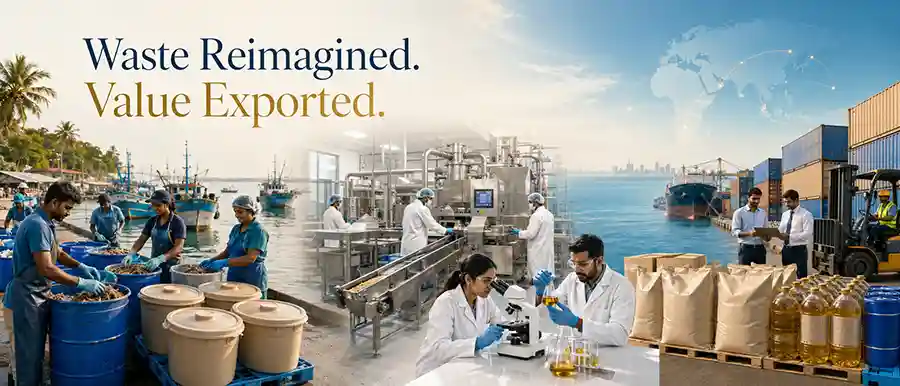
A BOI-approved operation in Puttalam is demonstrating how discarded fish by-products can become export-grade animal-feed ingredients, new income for fishing communities and a practical circular-economy solution. The opportunity now is to expand this model responsibly while protecting food resources, marine ecosystems and product quality.
For years, fish heads, frames, skins and internal organs discarded by markets and processors were treated mainly as an unpleasant waste problem.
When unmanaged, these by-products can create odour, attract pests, increase disposal costs and pollute coastal and urban environments. Yet much of this material still contains valuable protein, oils and nutrients that can be recovered and used in animal feed, aquaculture and other specialised products.
A Sri Lankan enterprise in Madurankuliya, Puttalam, is showing what can happen when this waste stream is approached as an industrial resource rather than rubbish.
Yesol Lanka, a Board of Investment-approved project, reportedly collects fish-processing by-products and converts them into fishmeal, fish oil and fish paste for export markets. The operation was developed by entrepreneur Vijitha Kumara Rajapaksa after he gained experience with animal-feed manufacturing in South Korea and returned to establish a similar value-addition model in Sri Lanka.
The project provides a useful case study in circular-economy development: recovering value from material that would otherwise be discarded while creating employment, export earnings and an additional income stream for suppliers.
However, its wider significance reaches beyond one factory.
Sri Lanka’s fisheries sector produces large volumes of biological material at landing sites, wholesale markets, harbours, dried-fish operations, restaurants and processing facilities. Building a well-regulated system to collect and process those by-products could help the country reduce pollution, strengthen export manufacturing and move further up the marine-products value chain.
A $3 Million Investment Built Around Material Once Thrown Away
According to the project information reported by the Daily FT, Yesol Lanka was established on approximately 50 acres in Madurankuliya with an investment of about US$3 million.
The operation reportedly employs 45 people directly and supports additional indirect livelihoods through collection, transport and supply activities. Its installed capacity is said to be approximately 100 metric tonnes of fish waste per day, while current island-wide collection for the operation is reported at around 50–70 metric tonnes daily.
Fishers and collectors are reportedly paid approximately Rs.20–30 per kilogram for material that previously had little or no commercial value.
That payment mechanism is important.
A circular-economy model becomes stronger when waste holders have a financial reason to separate, store and deliver by-products properly rather than dumping them into the sea, drains or general rubbish.
The model therefore creates several linked benefits:
- Fishers and processors can earn from previously discarded material.
- Local authorities may face less pressure from organic-waste disposal.
- The factory receives a regular raw-material supply.
- Export products generate foreign currency.
- Coastal and market environments can become cleaner.
- Collection and transport networks can create indirect employment.
The project shows how environmental protection and commercial activity do not always have to compete. When designed properly, one can support the other.
Figures are based on project information reported in July 2026 and may change as collection, production and export activity develops.
What Happens Inside the Processing Operation?
Fish-processing by-products are highly perishable.
Without temperature control, rapid collection and hygienic handling, the material can deteriorate quickly and create health, odour and quality problems.
A commercial recovery system therefore requires more than simply collecting waste.
It needs:
- Source separation
- Suitable containers
- Regular collection schedules
- Refrigerated or time-controlled transport where required
- Traceability
- Laboratory testing
- Controlled processing temperatures
- Product-quality verification
- Safe storage
- Export-compliant packaging
The reported Yesol Lanka production system includes batch laboratory testing and machinery capable of processing around 15 tonnes of material at a time at temperatures of approximately 120°C.
The final products reportedly include fishmeal, fish oil and fish paste.
Fishmeal is a concentrated source of protein commonly used in aquaculture and animal-feed formulations. Fish oil provides valuable fatty acids and energy, while pastes and hydrolysed products can be used for specialised feed and industrial applications depending on their specifications.
The Food and Agriculture Organization notes that fish-processing by-products have historically been discarded or directed into fishmeal, and that better utilisation can reduce economic loss and environmental problems.
FAO material also confirms that fishmeal may be produced from both whole fish and processing by-products such as offal and trimmings.
The most responsible model is one that prioritises material that is genuinely unsuitable or unnecessary for direct human consumption rather than diverting edible fish away from food markets.
The Difference Between Waste Disposal and Waste Valorisation
Waste disposal focuses on removing a problem.
Waste valorisation focuses on recovering the highest practical value from that material.
For example, fish by-products may potentially be processed into:
- Human-food ingredients where safe and culturally acceptable
- Nutraceutical or pharmaceutical inputs
- Collagen and gelatin
- Fish protein hydrolysates
- Pet-food ingredients
- Aquaculture feed
- Fishmeal and fish oil
- Organic fertiliser
- Biogas or energy products
Not every by-product is suitable for every use.
The appropriate pathway depends on freshness, species, contamination risk, processing technology, certification, market demand and whether the material could first be used for human food.
A strong circular system normally follows a value hierarchy.
Higher-value human-food or specialised products should be considered where practical. Feed, fertiliser and energy recovery can then absorb materials that are less suitable for premium applications.
Simply turning all material into low-value meal may solve a disposal problem, but it may not capture the greatest possible economic value.
Different By-products Can Support Different Markets
Food ingredients, nutraceuticals, collagen and specialised extracts
Fish protein, hydrolysates, fishmeal, fish oil and pet-food inputs
Fertiliser, biogas, composting and other controlled industrial uses
The safest and highest-value use depends on freshness, traceability, processing quality and regulatory approval.
Export Earnings Show the Commercial Potential
The company reportedly exports approximately 30,000–35,000 metric tonnes of fishmeal, fish oil and fish paste annually, generating about US$2 million to US$2.5 million in annual foreign-exchange earnings. Its reported buyers include a major Vietnamese aquaculture business.
Those figures illustrate the potential scale of demand for marine feed ingredients.
Aquaculture continues to require protein and oil inputs, while pet-food and livestock-feed industries also seek traceable, nutritionally consistent ingredients.
The Asia-Pacific region is particularly important because it includes several of the world’s largest aquaculture-producing and feed-consuming countries.
Sri Lanka’s location near India, Southeast Asia and major shipping routes could therefore support a competitive export industry—provided producers can offer reliable volumes, certified quality and consistent specifications.
The opportunity is not limited to exporting basic fishmeal.
More refined products, including protein hydrolysates, oils with specific quality characteristics and pet-food-grade ingredients, may command higher prices where producers meet demanding international standards.
However, premium markets normally require:
- Strong traceability
- Reliable laboratory results
- Hygienic collection
- Consistent protein and fat specifications
- Contaminant controls
- Sustainable sourcing
- Auditable environmental practices
- Approved production facilities
- Buyer-specific certification
Sri Lanka should therefore focus not only on increasing tonnage, but also on improving the value earned from every kilogram of recovered material.
A Cleaner Coastline Requires a Complete Collection Network
A factory cannot solve a national waste problem unless material can reach it safely and economically.
Fish waste is generated in many locations:
- Fishing harbours
- Landing sites
- Wholesale markets
- Municipal markets
- Supermarkets
- Hotels and restaurants
- Dried-fish facilities
- Canning and seafood-processing plants
- Export-processing operations
Each source may produce different quantities and qualities of material.
A large processing plant can manage predictable industrial volumes more easily than small amounts scattered across distant coastal communities.
Sri Lanka therefore needs an organised supply network.
This could include registered collectors, sealed containers, designated collection points, route planning, hygiene training and agreements with local authorities, fisheries organisations and market operators.
Collection systems must also prevent unsuitable material from entering the chain.
Plastic, hooks, packaging, chemicals, spoiled waste and mixed municipal rubbish can affect both product safety and machinery.
Clear separation at the source is usually cheaper and more effective than attempting to remove contamination later.
Income for Fishing Communities Can Extend Beyond the Catch
Fishing livelihoods are often affected by weather, fuel costs, seasonal availability, market prices and damaged catch.
Income from by-products will not replace the main value of edible fish, but it can create an additional revenue stream from parts that previously produced no return.
Collectors, small transport operators, sorters and local collection-centre staff may also benefit.
This is particularly useful when value is retained close to fishing communities rather than concentrated entirely at the final processing plant.
A fair supply system should provide:
- Transparent payment rates
- Reliable weighing
- Clear quality standards
- Timely payments
- Safe handling guidance
- Protective equipment
- Predictable collection
- Opportunities for cooperatives and small businesses
The system should not encourage fishers to catch species merely for reduction into feed.
Its purpose should be to recover unavoidable by-products from legitimate fishing and seafood-processing activity.
- Separate by-products from plastics and general rubbish at source
- Use sealed, washable containers and scheduled collection
- Maintain records showing where each batch originated
- Pay suppliers transparently using verified weights and quality
- Prevent edible or illegally caught fish entering the waste stream
Environmental Benefits Must Be Measured, Not Assumed
Using waste as a raw material can reduce disposal pressure, but an operation is not automatically sustainable merely because it processes waste.
Environmental performance should be assessed across the complete production cycle.
Important considerations include:
- Energy used in cooking and drying
- Water consumption
- Wastewater treatment
- Odour control
- Air emissions
- Transport distances
- Packaging
- Solid residues
- Chemical use
- Worker health and safety
The project reportedly achieved “100% Green Project” status after replacing certain export-packaging materials with recyclable intermediate bulk containers and plastic pallets.
Packaging improvement is valuable, but long-term environmental credibility depends on transparent measurement of the factory’s full footprint.
Public reporting could include the quantity of waste diverted from uncontrolled disposal, energy use per tonne, water recycling, wastewater quality, emissions, rejected material and the percentage of packaging reused.
This would help buyers, regulators and communities assess the actual benefit.
Expansion Must Protect Food Security and Fisheries Sustainability
A growing fishmeal industry can create unintended incentives if controls are weak.
FAO research has cautioned that expanded processing capacity intended for waste recovery could also increase demand for whole fish, including fish that might otherwise be used for human consumption.
Sri Lanka must therefore maintain a clear distinction between:
- Genuine processing waste
- Low-value by-catch that can legally be used
- Edible fish suitable for food markets
- Juvenile or protected species
- Illegally caught fish
The highest priority should remain responsible fisheries management and food security.
Waste recovery should improve the utilisation of the existing catch—not justify unnecessary harvesting.
Controls may include source records, species identification, landing documentation, inspections and clear restrictions on purchasing protected or undersized fish.
International buyers are increasingly interested in the sustainability and traceability of marine ingredients.
A processor that cannot prove its sourcing practices may face reputational and market-access risks even when its factory technology is strong.
Sri Lanka Can Build a Wider Marine Bioeconomy
Fishmeal and fish oil can provide a foundation, but Sri Lanka’s longer-term opportunity is a diversified marine bioeconomy.
Universities, technical institutes and businesses could explore:
- Collagen from skin and scales
- Gelatin
- Omega-rich oils
- Protein hydrolysates
- Pet-food ingredients
- Flavour compounds
- Calcium products from bones
- Chitin and chitosan from shellfish waste
- Organic fertilisers
- Biogas from unusable organic residues
Developing these products requires science, investment and market partnerships.
It also creates opportunities for food technologists, chemists, engineers, microbiologists, quality professionals and entrepreneurs.
Sri Lanka’s universities and research institutions can help test product safety, improve extraction methods and develop commercially viable applications suited to local species.
The BOI, Export Development Board, fisheries authorities, local councils and environmental agencies also need coordinated policies.
Investors should not have to navigate contradictory rules between collection, transport, factory approval, environmental licensing and export certification.
At the same time, approvals must remain rigorous enough to protect communities and the environment.
Entrepreneurship Built on Knowledge Acquired Overseas
The Yesol Lanka story also highlights the value of skills and knowledge gained by Sri Lankans working abroad.
Rajapaksa reportedly spent about a decade working within a South Korean animal-feed group before returning with the experience needed to establish the Sri Lankan operation.
This is an important form of national development.
Migrant workers do not return only with savings. They can also bring:
- Technical knowledge
- Production discipline
- International contacts
- Quality systems
- Market understanding
- Management experience
- New business ideas
Sri Lanka can benefit by creating clearer pathways for experienced returnees to establish export-oriented enterprises.
Support could include transparent approvals, industrial land, laboratory access, technical certification, export facilitation and links to financing.
The strongest incentives are not always tax concessions.
Predictable regulation, efficient public administration and access to reliable infrastructure can be equally important.
What Sri Lanka Should Do Next
The success of one operation should be treated as a starting point rather than proof that the national system is complete.
A larger strategy could include several practical actions.
Map the national waste stream
Authorities should identify where fish by-products are generated, in what quantities and with what seasonal variations.
Establish collection standards
Containers, transport times, cleaning, traceability and payment practices should be standardised.
Support regional processing hubs
Smaller pre-processing or chilling centres could reduce spoilage and transport costs in distant fishing areas.
Develop certification capacity
Sri Lankan laboratories and auditors should be able to support the standards demanded by international buyers.
Encourage higher-value products
Research grants and investment incentives could support protein hydrolysates, specialised oils, collagen and pet-food ingredients.
Monitor fisheries impact
Regulators must ensure that waste demand does not encourage overfishing or the diversion of edible catch.
Publish environmental performance
Factories should report measurable waste diversion, wastewater, energy and emissions outcomes.
Include small-scale communities
Fishers, processors, women’s groups, cooperatives and local entrepreneurs should have fair opportunities to participate in the supply chain.
A Model for Circular-Economy Investment
Sri Lanka has often discussed the need to increase exports, create jobs and reduce environmental pollution as separate policy goals.
The fish-waste recovery model shows that they can be addressed together.
A discarded material becomes a paid commodity. A disposal cost becomes industrial input. Pollution is reduced, new employment is created and finished products enter global markets.
The model is especially relevant for a country with limited landfill capacity, valuable marine resources and a continuing need for foreign-exchange earnings.
However, success should be measured by more than export revenue.
A truly sustainable industry must also demonstrate:
- Responsible fisheries sourcing
- Safe working conditions
- Fair supplier payments
- Effective wastewater and odour management
- Transparent environmental performance
- High product quality
- Long-term community benefit
When these foundations are strong, circular-economy businesses can contribute to both national growth and environmental recovery.
Sri Lanka’s next export opportunity may not always begin with a new raw material. It may begin by recognising the value hidden inside what the country already throws away.
The challenge is to scale circular industries without compromising food security, fisheries sustainability, product quality or coastal communities.
