
Sri Lankan Heritage & Global Legacy
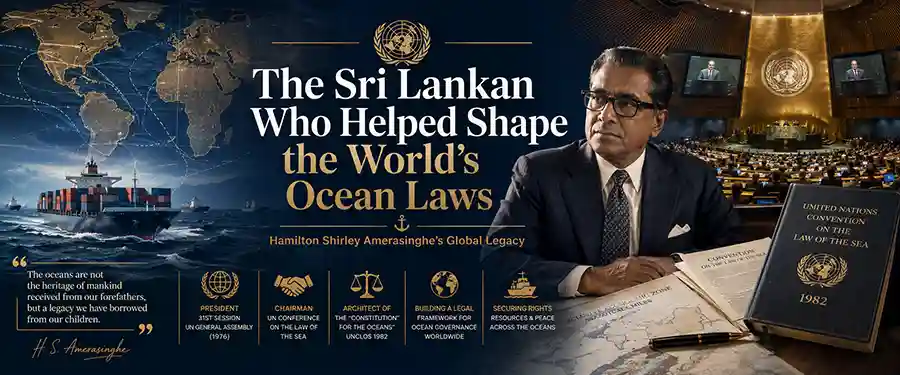
How Hamilton Shirley Amerasinghe Helped Shape Modern International Ocean Law Through His Leadership of the United Nations Law of the Sea Conference, Leaving a Lasting Sri Lankan Legacy That Continues to Influence Maritime Boundaries, Global Shipping, Marine Resources and International Ocean Governance Across the World
Some Sri Lankans have changed the course of world history—not through military power or political dominance, but through diplomacy, wisdom and international leadership.
One such individual was Deshamanya Hamilton Shirley Amerasinghe, a distinguished diplomat whose influence continues to shape the way nations use, protect and govern the world’s oceans today.
Although his name is not widely known among younger generations, his contribution to international law is recognised by diplomats, legal scholars and governments around the globe.
As President of the Third United Nations Conference on the Law of the Sea (UNCLOS III) and President of the 31st Session of the United Nations General Assembly, Hamilton Shirley Amerasinghe played a central role in guiding one of the most complex international negotiations in modern history.
The result was the United Nations Convention on the Law of the Sea (UNCLOS)—a landmark treaty often described as the “Constitution for the Oceans.”
His leadership helped build consensus among more than 150 nations with different political systems, economic interests and maritime priorities, creating a legal framework that continues to govern the world’s oceans decades later.
For Sri Lanka, this remains one of the country’s greatest diplomatic achievements on the global stage.
🌊 Ocean Law at a Glance
UN Leadership
President of the 31st United Nations General Assembly in 1976.
UNCLOS III
Presided over the Third United Nations Conference on the Law of the Sea.
150+ Nations
Guided negotiations involving countries from across the world.
Global Legacy
Helped shape the international legal framework governing the world’s oceans.
A Brilliant Beginning in Colonial Ceylon
Hamilton Shirley Amerasinghe was born on 18 March 1913 in Colombo during the period of British Ceylon.
He received his early education at the prestigious Royal College Colombo, where he developed the academic discipline and leadership qualities that would later define his distinguished public service career.
He continued his higher education at University College Ceylon, one of the country’s leading institutions before joining the Ceylon Civil Service (CCS).
At the time, the CCS was regarded as one of the most respected public services in Asia, recruiting only the nation’s brightest minds through highly competitive examinations.
Amerasinghe quickly established a reputation for intelligence, professionalism and exceptional administrative ability.
From Civil Servant to International Diplomat
During the early decades of Sri Lanka’s independence, Hamilton Shirley Amerasinghe held several important government positions before moving into diplomacy.
His calm personality, analytical thinking and remarkable negotiation skills earned him increasing responsibilities within the Ministry of Foreign Affairs.
In 1967, he was appointed Sri Lanka’s Permanent Representative to the United Nations in New York.
Representing a relatively small developing nation among the world’s major powers required exceptional diplomatic ability.
Yet Amerasinghe soon gained widespread respect for his balanced approach, persuasive communication skills and commitment to international cooperation.
He became recognised as a diplomat capable of bringing together countries with very different political interests.
📜 A Timeline of Global Leadership
Hamilton Shirley Amerasinghe was born on 18 March 1913.
Appointed Sri Lanka’s Permanent Representative to the United Nations.
Elected President of the 31st Session of the UN General Assembly.
Presided over negotiations that led to the United Nations Convention on the Law of the Sea.
Passed away while continuing his international diplomatic work.
Reaching One of the Highest Positions at the United Nations
Hamilton Shirley Amerasinghe’s growing international reputation culminated in one of the greatest honours ever received by a Sri Lankan diplomat.
In 1976, he was elected President of the 31st Session of the United Nations General Assembly.
The General Assembly is one of the UN’s principal organs, bringing together representatives from virtually every nation in the world.
Presiding over its annual session requires neutrality, diplomatic judgment and the ability to guide complex international discussions.
His election reflected the confidence that the global community had in his leadership and integrity.
For Sri Lanka, it was a moment of immense national pride, demonstrating that leadership on the international stage is determined by capability rather than the size or power of a country.
The Challenge of Governing the World’s Oceans
During the 1970s, disputes over the world’s oceans were becoming increasingly complex.
Countries disagreed over fishing rights, offshore oil and gas exploration, shipping routes, seabed resources and maritime boundaries.
Without common international rules, these disagreements had the potential to create serious political and economic tensions.
Recognising the need for a comprehensive legal framework, the United Nations convened the Third United Nations Conference on the Law of the Sea.
The conference brought together more than 150 countries, each with different priorities and competing national interests.
Finding common ground among so many nations was considered one of the greatest diplomatic challenges of the twentieth century.
Leading One of History’s Most Complex Negotiations
Hamilton Shirley Amerasinghe was unanimously chosen to preside over the conference.
This was an extraordinary vote of confidence from the international community.
Rather than representing only Sri Lanka, he became the impartial leader responsible for guiding negotiations involving countries from every region of the world.
The discussions continued for several years and covered issues ranging from territorial waters and navigation rights to deep-sea mining and marine environmental protection.
His greatest achievement was not writing international law alone, but helping nations with competing interests reach consensus through patient diplomacy, careful negotiation and mutual respect.
Many international observers credit his leadership as one of the key reasons the negotiations progressed successfully.
The “Constitution for the Oceans”
The work of the conference eventually led to the United Nations Convention on the Law of the Sea (UNCLOS).
Often described as the “Constitution for the Oceans,” UNCLOS established comprehensive rules governing the use and protection of the world’s oceans.
The convention introduced internationally recognised principles covering:
- Territorial seas
- Exclusive Economic Zones (EEZs)
- Continental shelves
- Freedom of navigation
- Marine scientific research
- Environmental protection
- Sustainable use of marine resources
Today, these principles continue to influence international maritime law and are used by countries around the world when managing their ocean territories and resolving maritime disputes.
Although UNCLOS was the result of collective negotiations involving many nations, Hamilton Shirley Amerasinghe’s leadership was widely recognised as instrumental in helping achieve this historic agreement.
🌎 Why UNCLOS Still Matters Today
| Area | Global Importance |
|---|---|
| Exclusive Economic Zones | Determines countries’ rights over marine resources up to 200 nautical miles. |
| International Shipping | Protects freedom of navigation for global trade. |
| Marine Resources | Provides legal rules for fisheries, offshore oil and natural gas. |
| Environmental Protection | Supports responsible management of oceans and marine ecosystems. |
| Dispute Resolution | Provides peaceful legal mechanisms for resolving maritime disputes. |
Why His Legacy Still Matters Today
Many people are unaware that decisions affecting international shipping, offshore energy exploration, fisheries and maritime boundaries are guided by principles developed through the Law of the Sea negotiations.
Every day, thousands of commercial ships travel safely across international waters under rules influenced by UNCLOS.
Countries determine their Exclusive Economic Zones, manage offshore resources and cooperate on maritime issues using the legal framework established by the convention.
In this way, Hamilton Shirley Amerasinghe’s contribution continues to influence global trade, environmental protection and international relations decades after his passing.
A Legacy Every Sri Lankan Should Remember
Hamilton Shirley Amerasinghe passed away in New York on 4 December 1980, before witnessing the full global implementation of the convention he helped guide.
However, his contribution did not end with his lifetime.
The Hamilton Shirley Amerasinghe Memorial Fellowship on the Law of the Sea was later established by the United Nations to honour his outstanding contribution to international maritime law and to support future experts in this important field.
Few Sri Lankans have left such a profound and lasting mark on the international legal system.
His story reminds us that diplomacy, knowledge and principled leadership can shape the world just as powerfully as military or economic strength.
🌐 How Ocean Law Affects Everyday Life
Although few people realise it, international ocean law influences global trade, communication, energy security and environmental protection every single day.
Final Thoughts
Hamilton Shirley Amerasinghe may not be a household name, but his influence extends across every ocean on Earth.
From helping guide one of the most important diplomatic negotiations in United Nations history to laying the foundations for the modern law governing the seas, his achievements continue to benefit nations across the globe.
His life is a powerful reminder that Sri Lanka has produced leaders capable of making extraordinary contributions to humanity.
As future generations learn more about his remarkable legacy, Hamilton Shirley Amerasinghe deserves to be remembered not only as one of Sri Lanka’s greatest diplomats, but also as one of the principal architects of the international legal framework that helps govern the world’s oceans today.
Editorial Note: This article is based on historical records relating to Hamilton Shirley Amerasinghe’s diplomatic career, his presidency of the 31st United Nations General Assembly, his leadership of the Third United Nations Conference on the Law of the Sea, and the internationally recognised role of UNCLOS as the legal framework governing the world’s oceans. Care has been taken to avoid overstating his role by distinguishing his leadership in building international consensus from the collective negotiations undertaken by participating states.
